Why this rooftop swap matters
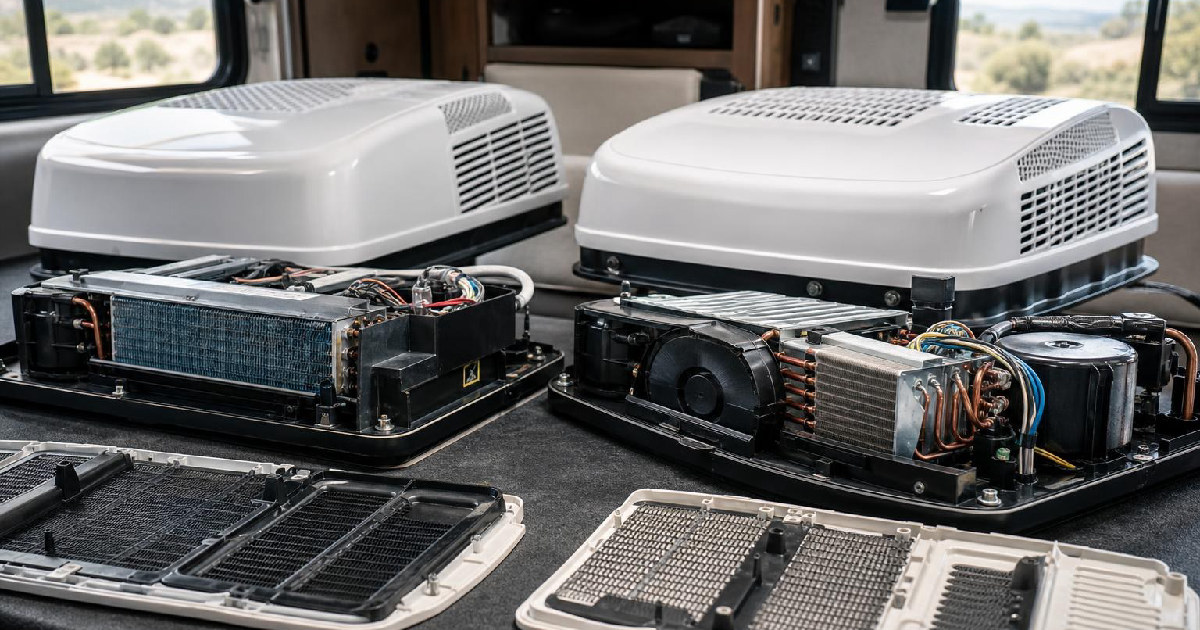
The plain answer is that this video is about replacing an older fixed-speed rooftop air conditioner with an inverter RV air conditioner and seeing whether the newer design actually changes life in the coach. The more useful answer is that it tackles a long-running RV problem: rooftop ACs have often been loud, power-hungry, and a step behind residential cooling technology. Mortons on the Move treats that gap as the whole story here. The question is not just whether the new unit turns on and blows cold air. It is whether inverter-based hardware can make a ducted RV feel calmer, cooler, and easier to power.
That framing matters because the channel is not testing this as a showroom curiosity. The unit goes into a real motorhome, the old Dometic Duo Therm is measured in place, and the comparison is built around actual use rather than a perfect lab setup. The result is less about hype and more about what changes when fixed-speed RV cooling is replaced by variable-speed logic borrowed from mini-split style systems.
What inverter technology changes in an RV AC
The key shift is simple to understand even if the engineering underneath is not. Instead of running only in an on-or-off pattern, the new unit can slow the compressor and fan to match demand. That means it does not have to slam on, overshoot, shut off, and repeat the cycle. In the video, that difference shows up as smoother temperature control, lower noise, and lower power draw.
The creator also makes an important distinction about the word inverter. The bigger practical point, as he explains it, is variable compressor control rather than the buzzword itself. In this setup, that control is what makes the unit feel more like the mini-split systems many RV owners already associate with efficiency.
The unit in question is the Turbro Greenland inverter rooftop air conditioner. It is presented as a direct-from-China product with mini-split style ideas adapted into an RV rooftop format. That is part of what makes the test interesting: it is not simply another version of the same old box. It is an attempt to change how a rooftop AC behaves.
How the install had to be adapted for a ducted coach
One of the most useful parts of the video is that it does not pretend every RV installation is the same. This coach is ducted, which means the AC has to feed air into a central duct system rather than dumping it straight down into the room. The new unit was designed as a non-ducted model, so the installation required modification.
That led to a custom adapter, including a 3D-printed duct piece to move the outlet to the correct position. The creator also worked on an air-turning piece meant to guide airflow into the duct at a better angle. He is careful to say that this added piece could affect the comparison with the older unit, which is exactly the kind of honesty that makes the test useful. He is not smoothing over the fact that the install itself influences the outcome.
Condensate management also came up as a real-world challenge. The coach uses a drain setup so water does not drip onto the roof, and the new unit needed some adjustment to fit that arrangement cleanly. None of that is glamorous, but it is the actual work RV owners run into when a new product has not been tailored to their exact layout.
What the measurements showed about cooling, power, and noise
The strongest part of the video is the data comparison. The old Dometic Duo Therm topped out at around 9,000 BTUs in the creator’s setup, with an Energy Efficiency Ratio in the 5.5 to 5.6 range at maximum. The new Turbro unit reached about 12,500 BTUs and came in around an EER of 11.5 at full output in the same setup. That is the clearest takeaway from the test: the new unit delivered substantially better efficiency in the coach as installed.
At lower output, the numbers got even more interesting. The creator says the inverter unit could ramp down to roughly 400 to 500 watts and still provide around 8,000 BTUs, with an EER that appeared to be even higher. He does not oversell that figure as laboratory certainty, but he does present it as what the coach actually captured. That distinction matters because the point of the test is comparison, not certification.
Cooling is only part of the story. The creator also tracked temperature drop, airflow, and power factor. The new unit showed a larger temperature drop and noticeably better ability to hold the cabin at a steady level without the constant stop-start behavior of a fixed-speed unit. In practical terms, that means less of the sudden blast and pause rhythm that many RV owners have just accepted as normal.
Noise was the other major win. The older unit measured around 67 decibels in the creator’s rough test. The new unit came in around 58 decibels before extra dampening and around 52 afterward. Those are not professional lab readings, but they do support the same basic observation the creator makes throughout the video: the new AC is much easier to live with, especially from outside the coach, where the compressor noise is dramatically reduced.
Why the power factor talk actually matters
The video spends time on reactive power, and that section is worth keeping in the article because it explains why an inverter RV air conditioner is not only about raw watts. The creator notes that the old unit carried a much larger reactive load, while the inverter unit reduced that load sharply.
For a person plugged into campground power, that may not feel like a day-to-day concern. But the creator’s point is that generators and inverters do feel it. Less reactive load means the same cooling can be easier to supply from an inverter or generator. That is a meaningful shift for anyone trying to make an RV work off-grid or with limited electrical headroom.
Where the unit still feels unfinished
The video is positive, but it is not a puff piece. The creator is clear that the internal sound reduction is less dramatic than the exterior improvement. The rooftop unit is quieter outside, but the indoor air distribution still feels somewhat traditional. In his view, there is room to improve the internal fan control and maybe get more refinement from the ducted air handling side.
Control is another compromise. The unit works well through the app and remote, but there is no feedback loop on the remote, and it does not appear ready to plug into an RV control system. That may not bother everyone, but it is a limitation. Heat pump behavior is another small annoyance: the fan can’t be forced on the way the creator prefers in cooling mode, so the system behaves a bit differently in heating mode than he would like.
Even so, the overall impression is that the unit works better than expected. It handles heat pump mode down into the mid-40s in the creator’s testing, which he notes is an area where other RV heat pumps often struggle.
Why this could matter for the next generation of RV cooling
What makes this test compelling is not just that one product performed well. It is that it suggests a new direction for rooftop RV air conditioners. The creator points out that 12-volt variable-speed systems have already existed in other RV setups, but this is one of the first 110-volt rooftop units he has seen bring the same idea into a familiar format.
That is why the video lands as more than a product review. It is a preview of where RV cooling might be headed: quieter operation, less waste, better temperature control, and a more realistic path to running climate systems from generators or inverters without the old penalty of constant cycling.
The Turbro Greenland does not look like a finished revolution. It looks like an early, workable version of a much better idea. And for RV owners who have spent years tolerating loud rooftop units, that is enough to make the comparison worth paying attention to.
Watch the original video: https://www.youtube.com/watch?v=rsnWzNLYGOY
RECOMMENDATIONS
All About The Life designs from Texas Thread Theory, inspired by the places you go and the stories you bring back.

All About The Life Road Trip SUV Badge
A retro All About The Life road-trip badge featuring a rugged SUV, mountain roads, directional signs, and classic compass details. It’s the perfect design for back-road explorers, overlanders, weekend travelers, and anyone who likes their adventures with a full tank and no strict itinerary.