Amsterdam’s canals reward persistence, not just luck
The clearest answer to what happens in this video is simple: Bondi Treasure Hunter spends the day magnet fishing across Amsterdam and comes away with a mixed haul of modern clutter, coins, bikes, and one find that feels far more historical than the rest. The bigger story is not just what came up, but where it came from. The episode keeps moving between Amsterdam’s oldest canals and newer stretches of water, and that contrast shapes everything that follows.
In the oldest canal, the Demra, the search starts with the usual magnet fishing reality: a lot of false alarms, a bit of patience, and the occasional small surprise. The video makes clear that these canals can hold objects from different eras, but they do not hand anything over easily. Mud, depth, and time all work against the magnet. That is part of the appeal here. A canal that has been collecting dropped objects for centuries can still make you wait for the good bit.
What the hunt turned up before the big payoff
The early finds set the tone. Instead of a clean run of treasure, the magnet brings up a bike lock piece, a giant metal toothpick, a “historical metal femur” as described in the video, and a few crusty metal scraps. Later, there are coins, umbrella bits, clamp-like pieces, a vape, a beer bottle top, and more unidentifiable metal that seems to come up with a lot of Amsterdam mud attached to it.
That mix matters because it shows what these canals really are: not a museum, not a landfill, but both at once. The video keeps circling between the idea of old lost objects and the reality of fresh litter. A 1 cent or 5 cent coin might come up next to something that looks much older. A bike part can surface beside something the creator thinks could be from a much earlier period. The canal does not care about categories, and that is what makes the hunt interesting.
One of the more consistent threads is the number of coins. At one point, a magnet comes up loaded with them, and the reaction is less about exact value than about how unexpectedly dense the find is. It looks like a spot where a bag of money may have been dumped or dropped long ago. Later, another pass produces more coins, including a few that are handed to people watching nearby. The search turns into a small public event, with tourists, kids, and first-time magnet fishers getting pulled into the moment.
Why the red light district kept changing the tone
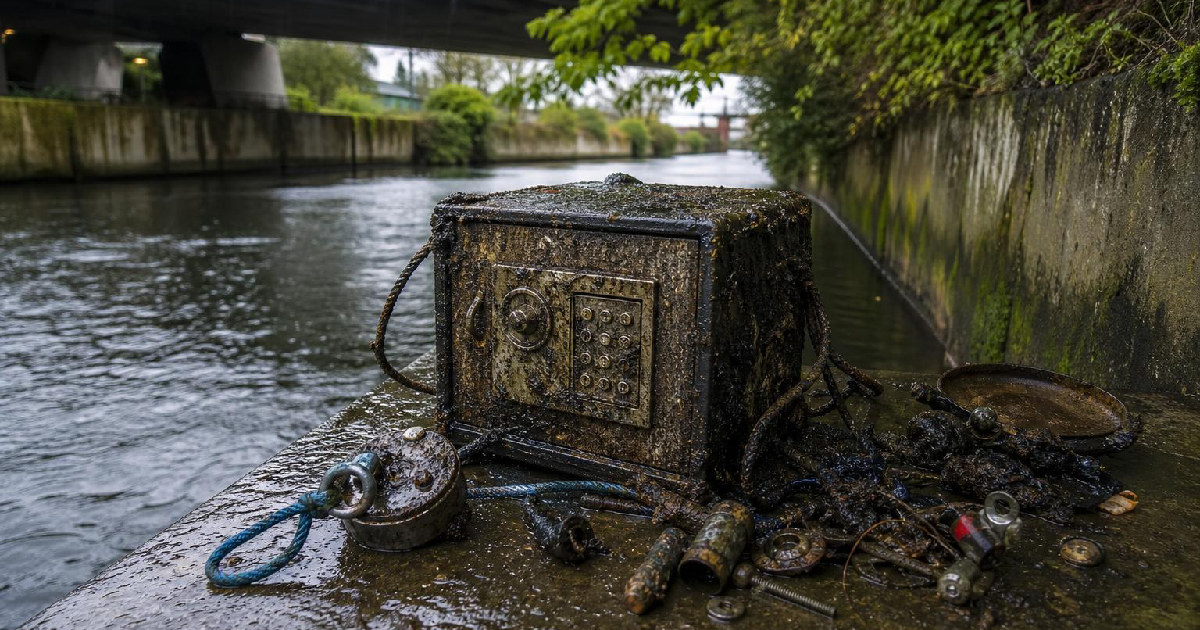
When the hunt moves into the red light district, the tone shifts without losing momentum. The video is careful about where filming can happen, but the area itself clearly changes the atmosphere. The buildings are old, the streets are busy, and the water seems to carry a different kind of history. The creator notes that he has found some memorable items in this part of Amsterdam before, including a safe on an earlier visit, and that memory hangs over the hunt even when the exact same kind of find does not repeat.
This section also shows how the canal hunt becomes partly social. Scottish fans stop for photos, a pair of Aussie kids watch the action, and first-time magnet fishers ask to try the magnet themselves. That interaction is not just decoration. It explains why these videos work as travel experiences as much as treasure hunts. The canal is the main character, but the crowd around it shapes the pace.
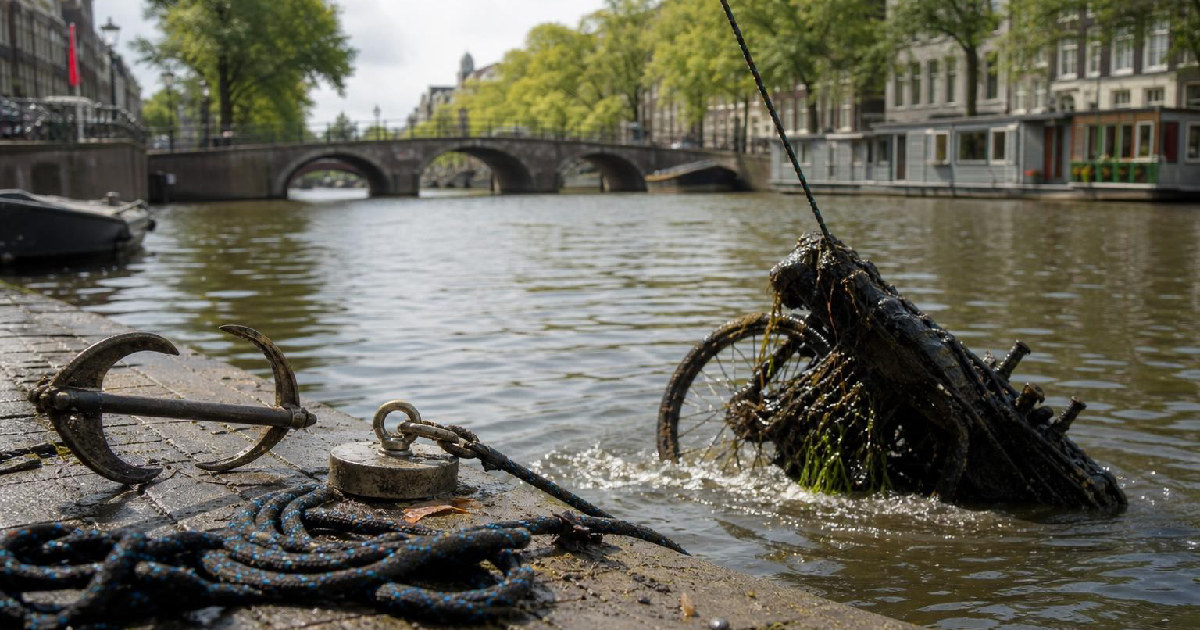
The red light district also delivers the episode’s best run of surprises. A bike comes up with its keys still in it, and then another bike follows. Later, a heavier cluster of finds includes a motorbike wheel, more scrap, and a crate-like piece caught in the mud. The video does not pretend those are all valuable in a financial sense. The interest is in what they say about the canal: this is a place where people have dropped, dumped, or lost things for a long time, and the water keeps storing the evidence.
The finds that felt old, the ones that did not
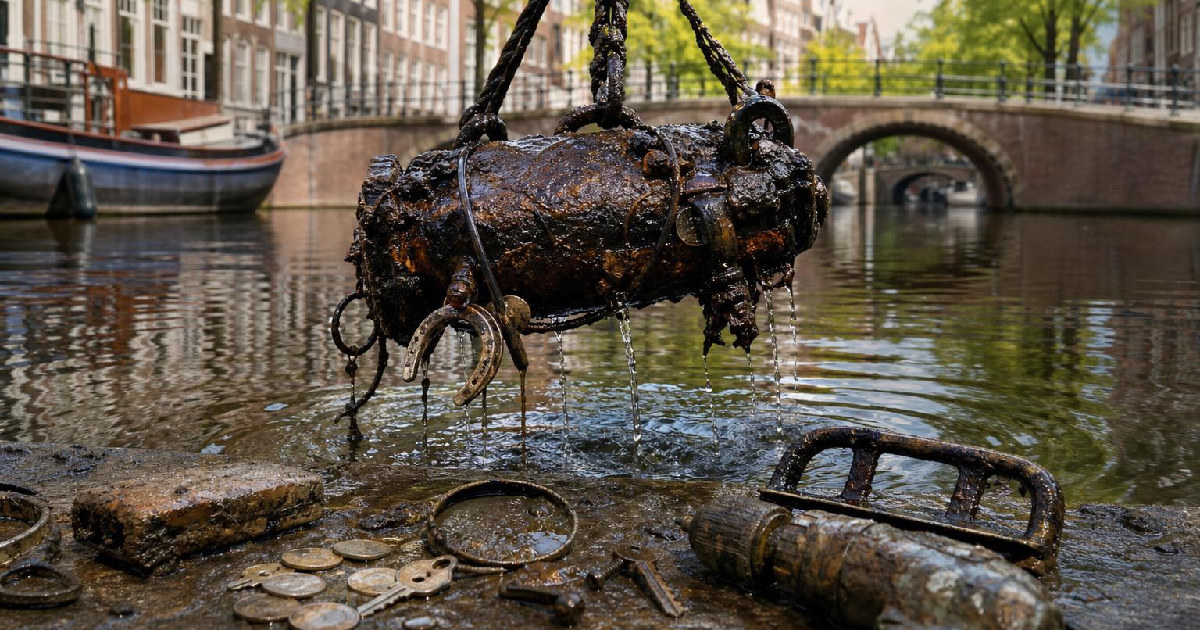
The most striking object in the episode is the helmet-shaped find. Bondi Treasure Hunter pauses on it immediately, treating it as something that could be much older than the everyday clutter around it. He suggests it might even be from World War I or World War II, but he does not claim to know. That restraint is important. The video clearly presents the object as potentially historical, but it stops short of pretending certainty where there is none.
That is the right balance for a feature like this. The canal is full of things that may look old, but only some of them feel like they belong to a deeper story. Square nails are mentioned as the sort of thing one might hope for in Amsterdam because they can signal older periods. The helmet-shaped piece is different because it carries that same sense of age and context without the video needing to overstate it. It is the kind of find that gives the whole hunt a reason to keep going.
On the other side of the spectrum, the newest canal shows how much the age of the water matters. This stretch was drained in 2020 during the coronavirus period and later built into an underwater bike station. The results there are much more modern: clean beer bottle tops, a few coins, and less of the deep, muddy accumulation that defines the older water. The contrast is plain. The oldest canal feels like layered history. The newest one feels like a cleaner, more recent storage area for lost everyday items.
Why this Amsterdam hunt keeps working as a story
What makes the video satisfying is not a single dramatic pull from the water. It is the way the day keeps changing shape. One minute there is a joke about canal showers. The next there is a bike being dragged free. Then a child gets a coin, a first-timer gets a turn, and a heavy object hints at something older under the mud. Even the food break in the red light district matters because it breaks the rhythm and reminds you that this is as much about moving through Amsterdam as it is about recovering objects from it.
If you are wondering whether Amsterdam canals are good for magnet fishing, this episode gives a pretty clear answer: yes, but in layers. There is the obvious modern clutter, the coin-heavy stretches, the bikes, and the scrap. Then there are the older-feeling finds that make the search worthwhile in a deeper way. The canal does not hand over history neatly. It gives you pieces, some obvious, some strange, and some that need a closer look later.
That is why the video lands. It is not just a hunt for treasure. It is a running reminder that city water keeps the memory of whatever people lose, throw away, or forget. In Amsterdam, that memory can look like a bike, a coin pile, a vape, or something that looks uncomfortably close to a wartime helmet.
Watch the original video: https://www.youtube.com/watch?v=8mDatSQ4D8E
RECOMMENDATIONS
All About The Life designs from Texas Thread Theory, inspired by the places you go and the stories you bring back.

Keep Exploring Badge
A vintage outdoor badge centered on one simple message: “Keep Exploring.” With mountains, evergreens, a river, hiking boots, lantern, map, and compass details, it’s made for hikers, campers, travelers, and anyone who is always curious about what’s around the next bend.