A river pull that turns from heavy to official
The direct answer to what happens in this video is simple: Bondi Treasure Hunter and a group of helpers pull a very heavy object out of an Amsterdam river, then turn the find over to police so they can check the license plate and figure out whether it was stolen and who it belongs to. The drama is real, but the useful part of the clip is the process. This is not just about dragging something surprising out of the water. It is about getting a stubborn object free, managing the weight, and making sure the find ends in the right hands.
That difference matters. A river recovery can easily stop at the moment of discovery. Here, the story keeps moving after the object surfaces. The physical effort is only the beginning; the second half is what gives the video its shape.
Why the magnets were not enough
The first clue that this is a bigger job than usual comes almost immediately: the object is too heavy for the magnets alone. The creator says he has something big down there, but once it starts coming up, the strain is obvious. He has to keep repositioning it, and at one point he calls for the grappling hook because the load is simply too much to manage comfortably by hand.
That detail gives the video its practical rhythm. This is river work that depends on adapting in real time. The magnets do the initial search and pull, but they are not the whole solution. Once the object breaks free enough to move, the grappling hook becomes the tool that helps control the drag and shift it into a better position.
The weight also changes the social dynamic on the bank. This is not a one-person lift. The creator asks for help, and the response is immediate. Several people step in to add muscle, and the tone becomes collaborative rather than solitary. The work looks messy, noisy, and physical, which is exactly what makes the recovery feel believable.
The crowd helps carry the moment
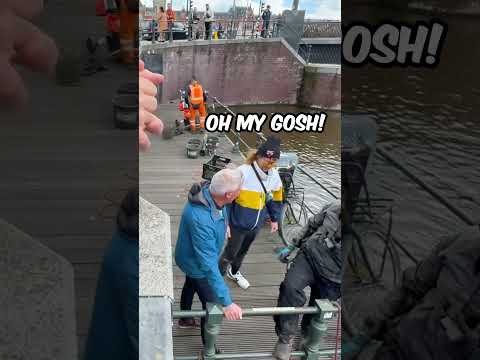
One of the most distinctive parts of the clip is how quickly passersby become part of the recovery. People are asked to help, and they do. The creator pauses for a break, lowers the load, and then looks for more strength in the crowd. A husband joins in. Younger guys are called over. Someone from Melbourne, Australia, gets a shout-out, which adds a small but memorable note of how international a city crowd can feel in the middle of an unexpected river recovery.
That crowd energy is not just background color. It is part of the mechanism that gets the object out. The video shows how these recoveries often become public events the moment the item is too heavy, too awkward, or too large for one person to handle alone. The crew on the bank has to coordinate the angle, the timing, and the release. At one point there is a shouted warning to watch out, then a synchronized effort to let go at the right moment.
The result is a messy but successful handoff from water to land. The object is no longer a mystery in the river; it is now something everyone can see, move, and identify.
What makes this find different from a normal treasure hunt
Although the video sits in the treasure-hunting world, it does not play like a search for a collectible or a forgotten personal item. The significance comes from the implication that this is a stolen vehicle-related recovery. The creator says police have come and will check the license plate to see when it was stolen, track down the owner, and return it to them.
That final step changes the emotional center of the clip. A heavy object pulled from a river can be interesting on its own, but here the object is also evidence and a lead. The license plate gives police a concrete place to start. The find is no longer just a win for the searchers; it becomes a route back to someone who lost something valuable.
This is where the video quietly becomes more than a spectacle. The payoff is not the lift itself, but the fact that the recovery can be documented and passed on in a way that may help close a theft case. The moment feels grounded because it stays focused on what can actually be verified in the clip: the police arrived, the plate will be checked, and the process moves from riverbank to official follow-up.
What the Amsterdam clip shows about river recovery work
River recovery is often presented as a hunt for surprises, but this short Amsterdam sequence shows the more ordinary truth underneath it: finding something is only half the challenge. You still have to move it, control it, identify it, and decide what happens next. In this case, the object is heavy enough to require tools and extra hands, and important enough to bring police into the picture.
That combination is what gives the video its appeal. It is a compact example of how treasure hunting can slide into cleanup, documentation, and recovery work all at once. There is tension in the lift, a little humor in the effort, and then a calm, practical ending when police take over.
For viewers, the real hook is not just the size of what came up. It is the chain of small decisions that made the recovery possible: use the magnets, switch to the grappling hook, recruit help, lower the load, and let the authorities handle the plate check. That is the kind of sequence that makes a short clip feel complete without needing anything added to it.
Watch the original video: https://www.youtube.com/watch?v=T1-wMbzneSI
RECOMMENDATIONS
All About The Life designs from Texas Thread Theory, inspired by the places you go and the stories you bring back.

Make A Story Worth Telling
A scenic vintage-inspired design that encourages you to “Make A Story Worth Telling.” Mountains, water, sunset, and tropical details give it an adventurous feel that’s perfect for travelers, explorers, and anyone who wants a life filled with moments worth remembering.