Why the home base made sense before the money did
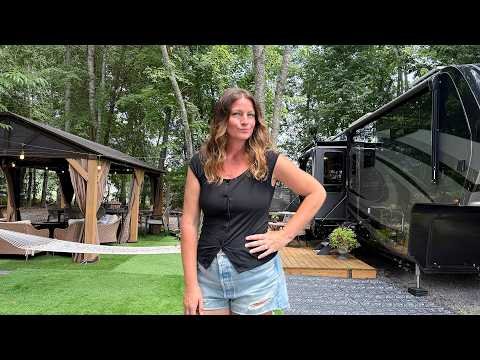
The simplest answer to what this video is about is this: Less Junk, More Journey spent seven years building an RV home base instead of buying a house, and the real question is not just how much it cost. The better question is what it solved. In their telling, the project began when full-time travel was no longer meeting every need their family had. They were expecting another child, they had already been on the road for years, and they found themselves looking at one familiar assumption—just buy a house—and asking whether a different answer might work better.
That shift matters. The video does not frame the home base as a rejection of RV life. It is more like a pressure-release valve for RV life as it got more complicated. For this family, the home base became a way to keep traveling while also creating a reliable place to come back to, regroup, and stop feeling like every practical problem had to be solved from scratch.
Phase one: a place to land
The first phase was all about basics. The property was wooded, and the family worked with land already tied to Marissa’s side. Nathan describes the early plan as a modest one: clear a section, create a spot for the rig, and set up the utilities they needed to function. That meant clearing trees, running septic and water, handling electric, laying gravel, and establishing multiple places to park.
This first phase is the backbone of the whole story because it shows what the home base was really for. It was not initially designed as a polished hangout spot. It was supposed to solve the practical problem of having nowhere to go. They were coming back from hospital time with a newborn, using a driveway when they had no campground opening, and trying to build a setup that would let them land instead of scramble.
Marissa also makes clear that full hookups were part of the appeal. After years of managing water, sewer, and electricity on the move, having a place where those decisions were already handled carried real weight. In their world, that kind of reliability was not a luxury. It was the difference between a stopover and something that felt like home.
Phase two: space for kids, play, and family rhythm
Once the basics were in place, the project expanded into something more personal. The second phase brought in the kinds of features that make a property feel lived in rather than merely occupied: a deck, a tree house, a zip line, a sand pit, a trampoline, a hot tub, chairs, fire pits, and later turf and more gathering space.
This is where the video gets especially revealing, because the family is not just talking about amenities. They are talking about childhood, familiarity, and the way a place can support a rhythm over time. Marissa speaks with real warmth about the woods she grew up in and how meaningful it is to see her kids playing there now. The tree house and zip line are not presented as status pieces. They are framed as a way to let the kids roam, play, and have their own place to return to.
The swing comes up as one of the most-used items on the property, which says a lot about the project’s priorities. Not every improvement needed to be dramatic. Some of the most valuable ones were the simplest: a place to sit, a place to swing, a place to throw in some outdoor time without needing a campground to provide it.
The hidden benefit: fewer daily decisions
One of the strongest themes in the video is something many full-time travelers will recognize immediately: decision fatigue. Nathan tells a story about spending nearly an hour looking for diesel in St. Louis, moving from one gas station to another and weighing safety, availability, and access before he could even refuel. That story becomes the larger point. Living on the road can mean choosing everything, all the time.
At the home base, those choices shrink. They know where to get fuel. They know where to get propane. They know where to take the truck for different kinds of service. They know where to get bread, where to get trash picked up, where to go to church, and where the dentist is. That kind of knowledge may sound ordinary, but the video treats it as a real quality-of-life improvement.
This is where the home base starts to look less like a property project and more like a mental reset. It did not remove the RV lifestyle; it reduced the friction inside it.
Why hosting other RVers changed the project
The video also shows how the meaning of the home base expanded once the family started using it to host other people. In their telling, one of the hard parts of RV life is gathering in a big way. You can absolutely meet up on the road, but creating a stable, private space for larger groups is different. The home base gave them that option.
That matters because community is part of the equation here. They mention reconnecting with RV friends from around the country, meeting people they first crossed paths with in Alaska, and using the property to bring together both traveling friends and local family. The home base becomes a meeting point between two lives: the one on the road and the one anchored in Tennessee.
The social function of the property seems just as important as the practical one. Once the place could hold a group, the project stopped being only about solving problems and started becoming a setting for memories.
The gazebo that turned the idea into a gathering place
If there is one feature that seems to mark the transition from useful land to real gathering space, it is the gazebo. Nathan describes it as their biggest single expense, and the video makes clear why. It is the piece that allows the property to work in more weather conditions and for more kinds of use. It has screens, a fan, a table, room for meals, room for kids to spread out, and enough flexibility to function as a chill zone, a meal area, and even a workout area.
It is also the most permanent-looking part of the project. They talk about poured footers and anchoring it down, which gives the structure a different kind of weight from the chairs, grills, or play items that can come and go. In narrative terms, the gazebo is where the home base starts to feel finished in spirit, even if the ongoing updates never really stop.
Marissa’s comment about wanting to “build a nest” fits here. That is really what the gazebo represents: not just square footage, but a way to gather, host, and settle into a place that feels intentionally made.
What they got wrong along the way
The video is refreshingly honest about the mistakes. The water setup froze in winter until Nathan changed the approach and installed a shutoff valve below ground. The Solo Stove did not last the way they hoped and was eventually replaced with a concrete-block fire pit. Some of the outdoor furniture wore out sooner than expected. The turf, while helpful, still requires maintenance and can suffer near heat sources.
There is also a broader mistake running underneath the whole story: the temptation to treat every challenge as a sign that they must get a house. They say that reaction came up more than once. What they learned instead was that challenges can be solved in stages. The home base was not built in one big leap, and that incremental method seems to be the reason it was manageable at all.
So, was it worth $18,000?
By the end of the video, their answer is clear enough. For them, yes. The home base gave them a place to land, cut down on daily friction, supported their kids, hosted their community, and let them stay on the road longer without pretending that RV life had no limits.
That does not mean the same answer fits everyone. Their own takeaway is more measured than that. You do not have to spend $18,000 on a home base, and you do not have to have one at all. But if the road is starting to feel like a series of small complications, this video makes a strong case for building some kind of anchor before those complications start to feel bigger than the lifestyle itself.
Watch the original video: https://www.youtube.com/watch?v=icZCIEN5dIQ
RECOMMENDATIONS
All About The Life designs from Texas Thread Theory, inspired by the places you go and the stories you bring back.

Calories Don’t Count On Adventures
A bright, playful travel design built around the unofficial rule that “Calories Don’t Count On Adventures.” With desserts, route graphics, outdoor gear, and mountain scenery, it’s perfect for road trips, vacations, food stops, and anyone who believes exploring is better with snacks.