Why this move felt bigger than a normal pack-up
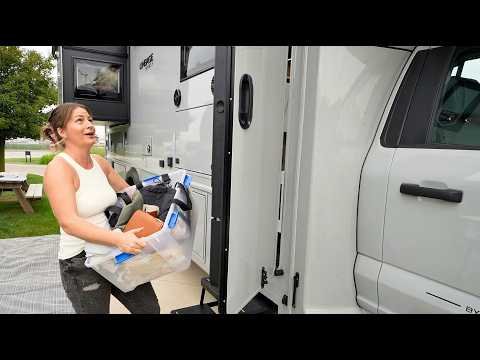
The plain answer is that this was not just a quick clean-out before a trip. It was a full life shuffle, with a family trying to move everything they needed for six weeks from a 44-foot fifth wheel into a 33-foot Super C, and they had only one day to do it. That changes the mood immediately. The task is not simply packing; it is deciding what counts as essential when your usual home-on-wheels suddenly has less room and the Jeep that would normally help carry some of the load is not yet attached.
That is the tension running through the whole video. The creators are not pretending this is easy, and they are not treating it like a neat before-and-after reveal. They are doing the messy middle of RV life: opening cabinets, moving boxes, reassessing what belongs where, and working through the kind of pressure that only shows up when departure time is real.
The storage math that changed everything
A lot of the video’s energy comes from the surprise of comparing spaces. The fifth wheel they are leaving behind is a prototype, and that matters because they explain that it still needs fixes that have already been resolved in production. Grand Design offers them the Super C while the fifth wheel gets sorted out, so the move becomes a temporary relocation with a hard deadline attached.
Once they start looking at the Super C, the first impression is not scarcity. It is potential. There is a lot of storage, and the layout gives them multiple places to sort the load: overhead spaces, pantry areas, outside bays, a pass-through section, and even compartments that can be accessed inside or outside. On paper, it sounds generous. In practice, the family quickly finds the limit is not whether there is storage at all, but what type of storage is available for the big awkward pieces of their life.
That is where the real issue appears. Small items can be tucked away. Pantry goods can be sorted. Clothes can be divided and folded. But the things that make travel feel normal — e-bikes, workout gear, camera equipment, coffee gear, kids’ supplies, and bulky seasonal items — demand more than open cabinets. They need specific-shaped places, and the video keeps circling back to that fact.
What had to be prioritized first
The family’s packing logic becomes clearer as they go. They keep returning to the same question: what do we use daily, what do we use weekly, and what can wait? That simple filter becomes their organizing principle.
Kitchen items and food move up the list early, which makes sense because they keep joking that food, cold, and being hungry are serious concerns. The fridge ends up feeling like one of the hardest parts to manage, especially since they are coming from something close to a residential-size fridge and now have to fit life into a tighter footprint. The coffee machine makes the cut too, which tells you a lot about how they think about routine. They are not trying to replicate home perfectly, but they are also not willing to abandon the everyday things that make a road trip feel livable.
Outside storage gets the same kind of triage. The family has workout equipment, tool boxes, hoses, electrical connections, and other travel essentials that need to stay accessible. The Jeep that will eventually be attached to the Super C becomes part of the storage strategy in theory, but since it is not there yet, the immediate challenge is moving the most necessary things into place without relying on the extra vehicle.
That is why some items get pushed aside. Big recreational gear and large accessories are not treated with sentimental protection. If a piece is too tall, too awkward, or too hard to place in the time available, it gets reclassified as optional. The video does not frame that as failure. It frames it as reality.
Where the family’s stuff actually landed
One of the most useful parts of the video is how concrete the packing decisions become. Pantry items migrate to one area. Clothes go where they can be reached. The kids get their own drawers. The closet becomes a mix of daily needs and overflow. The bathroom is used for makeup, towels, a heating pad, and other personal items. The electronics cabinet becomes a home for router and hotspot gear, with the relief of finding actual power there.
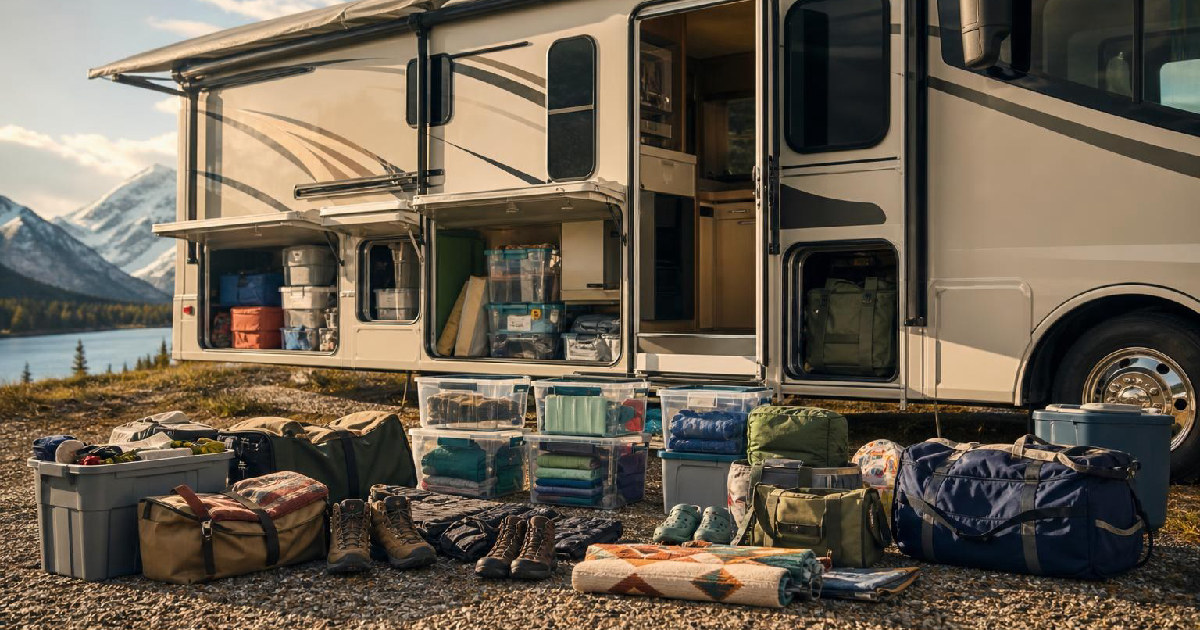
The outside bays end up being just as thoughtfully sorted. There is a workout bay with adjustable dumbbells, a weighted vest, a pull-up bar, a workout bench, and chairs. Another bay handles sewer and water-related gear. A separate spot holds electrical connections and other miscellaneous items. There is even an overflow crate for things that do not yet have a better home. That is a practical detail that says a lot: when space is tight, having a temporary holding place can keep the interior from turning into a constant pile.
The top bunk area becomes a small win for the kids. Hensley and JJ each end up with their own spaces, plus room for games and a few familiar things. The space above feels noticeably roomier than the one they had in the Mercedes, and the family seems relieved by that. In a long trip, comfort is not always about luxury. Sometimes it is about giving children a corner that feels like theirs.
The emotional lesson hiding inside the clutter
This video is funny in places, but underneath the jokes is a very ordinary kind of pressure: realizing how much stuff has quietly collected around a family that lives on the road. The creators say they have not really been weekend campers. Their whole way of living has been built around keeping nearly everything with them, so being forced to compress it all into a shorter motorhome changes the way they think.
That is the deeper story here. Downsizing is not just about square footage. It is about attention. It asks what you actually use, what you reach for out of habit, and what only feels necessary because it has always been there. At one point they even reflect that if they do not use something for six weeks, maybe it is worth reevaluating. That is a useful rule of thumb, and it comes out of the pressure of the moment rather than a tidy philosophy.
There is also a quiet family story running through the pack-up. Marissa’s concerns about being cold and hungry show up in the way the fridge and food are packed. Nathan keeps trying to organize by access and frequency of use. The kids arrive with their own needs and their own collections of things, from clothes to arts-and-crafts items to Pokemon cards. Nobody is being frivolous; everyone is bringing a version of comfort.
Why the road trip matters more than the reset
By the end, the move is less about proving that everything fits and more about proving that the family can still travel without losing the shape of their life. The Super C is not presented as a perfect substitute for the fifth wheel. It is a different setup with different strengths, and the video treats that honestly. The real payoff is the road trip ahead: the chance to keep exploring while the fifth wheel gets handled and the family adapts to a new temporary home.
That makes the video feel useful beyond its own storyline. Anyone thinking about RV packing for a 6-week road trip will recognize the same pressure points: food, clothes, electronics, hobbies, kids’ items, and the practical problem of things that are too large for the obvious storage spots. But the larger takeaway is even simpler. A move like this forces you to decide what your travel life is actually built around. Not everything makes the cut, and that is the point.
Watch the original video: https://www.youtube.com/watch?v=ZqQEvsNcM_w
RECOMMENDATIONS
All About The Life designs from Texas Thread Theory, inspired by the places you go and the stories you bring back.

Take The Scenic Route
A scenic-route AATL design built for road trips, mountain drives, sunsets, back roads, and travelers who know the long way can be the best way.