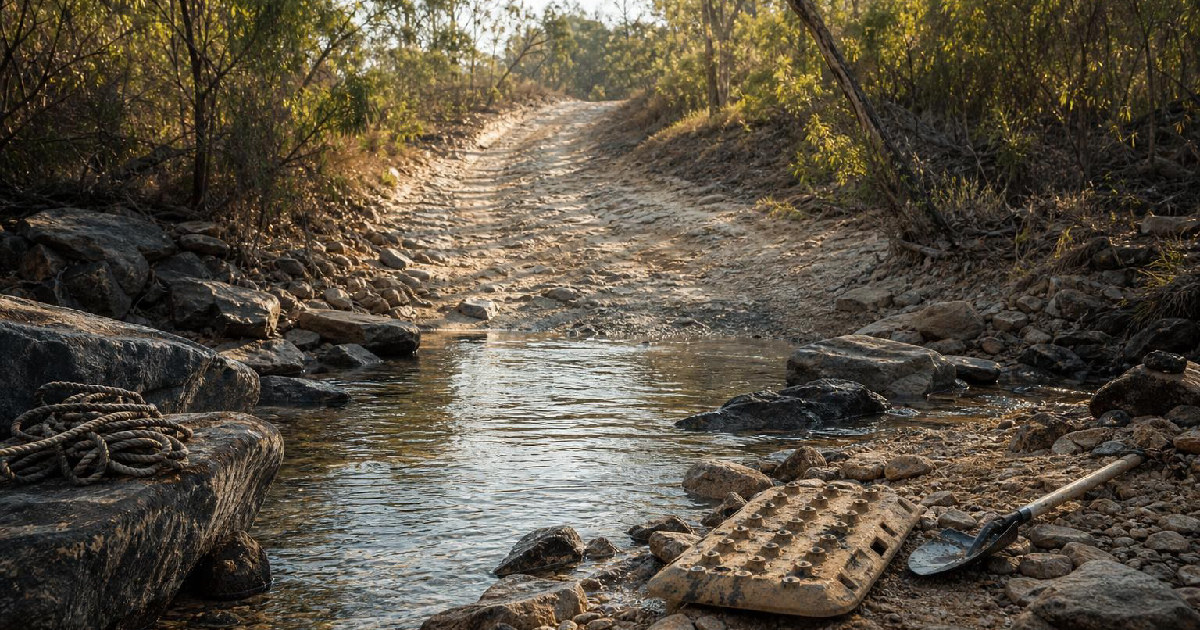
Why this stretch of the Old Telegraph Track turns into a slow-motion test
The clearest takeaway from this Cape York episode is simple: the Old Telegraph Track does not let anyone cruise for long. Ronny Dahl’s crew heads into the northern section after a late start on day four, and from there the trip becomes a chain of careful decisions rather than a clean run north. That is what makes this part of the OTT so compelling to watch. The challenge is not only the crossings themselves, but the way every obstacle seems to demand a fresh calculation about line, grip, width and timing.
The crew already arrives with a bit of fatigue in the mix after the previous day’s excitement and a bogged exit from Canal Creek. That matters, because this is not the sort of country where you can switch off and rely on momentum alone. The video keeps returning to the same idea in different forms: there is no point-and-shoot approach here. Even when a crossing looks manageable at first glance, the entry can drop away suddenly, the bottom can change texture mid-crossing, or the exit can become the real problem.
Cannibal Creek: where width, lean and recovery stop being abstract
Cannibal Creek is the section that really explains the title of the episode. The crew reaches it expecting a difficult stretch, but the track quickly becomes tighter, steeper and less forgiving than it first appears. The Grenadier’s width becomes a constant consideration, and that is one of the most interesting threads in the episode. The vehicle’s extra width helps in some places by giving more options for line choice, but in tight country it also forces the driver and spotter to think hard about every inch of space.
That pressure builds before the crew even gets fully into the creek. The rut deepens, the lean becomes more pronounced, and the wall on one side starts to feel uncomfortably close. The video shows how fast a line can become a problem when a vehicle is carrying weight, leaning off camber and losing room to correct. At that point, success is not about bravado. It is about trusting a spotter, listening carefully, and moving only as much as the track allows.
What stands out most is the repeated use of recovery gear and the way it is treated as part of the trip rather than a failure of it. Boards are laid in layers, rocks are bridged, and winching becomes a sensible tool instead of a last-ditch embarrassment. That practical attitude gives the episode its rhythm. The crew is not trying to dramatize being stuck; they are solving the problem the track has handed them.
The bridge everyone wants to photograph, and the clock that keeps ticking
By the time Cypress Creek arrives, the day has already taught the crew a blunt lesson: distance on the OTT is measured in effort, not kilometres. That is why the Cypress Creek log bridge lands with such force. It is iconic, and the video makes clear why people remember it. The bridge looks improvised, stubborn and completely at home in this kind of country. It is exactly the sort of thing that reminds viewers why the Old Telegraph Track has such a reputation.
But the bridge is not just a landmark. It is also part of the day’s problem. Light is fading, the crew still has ground to cover, and the atmosphere shifts from appreciation to urgency. They want the moment, but they also need to keep moving. That tension gives the sequence its energy. The bridge becomes a reward and a warning at the same time: you can enjoy the history and the spectacle, but the track will not pause while you do.
What the episode shows about convoy travel on the OTT
One of the strongest parts of the video is the relationship between driver and spotter. The footage makes it obvious that the crew is not simply following instructions mechanically. They are constantly interpreting what the vehicle is doing, where the suspension is loading up, how the rear is pivoting, and whether a change in angle will improve or worsen the situation. The best decisions here come from quick communication and a willingness to adjust the plan as soon as the track changes shape.
That becomes especially clear in the narrow sections where the crew has to use max tracks in a crisscross or staggered layout. The point is not just to get traction. It is to preserve as many options as possible while climbing a lean, off-camber section with a vehicle that may touch the wall. The video shows how technical the problem becomes once the lane and the vehicle start to match widths. At that stage, the spotter is almost doing the work of a second set of eyes, judging every inch for clearance and keeping the driver moving just enough to avoid bogging or slipping sideways.
The convoy dynamic matters too. When one vehicle is stuck, the other cannot simply push ahead and ignore the problem. On a track like this, the progress of each vehicle affects the other. That creates a kind of shared tempo that is easy to miss if you only think of 4WD travel as a series of independent crossings. Here, every recovery changes the pace of the day.
Why the northern OTT feels harder than the famous stories suggest
The video also quietly answers a question many people have about Cape York: why do the northern sections seem so much more demanding than the reputation might suggest? Part of the answer is erosion, which is visible throughout the track in the form of deeper ruts, soft sand and changed entry and exit angles. Part of it is the narrowing of choices. The further the crew goes, the less room there is to improvise.
Another part is simply cumulative fatigue. By the time the crew reaches Cannibal Creek and Cypress Creek, they are not dealing with one obstacle in isolation. They are dealing with a day’s worth of slow movement, repeated adjustments and the mental load of knowing another difficult section may be just ahead. That is what gives the episode its shape. It is not one big triumph scene. It is a long exercise in staying calm while the track keeps asking for more.
Why this section stays with viewers after the mud dries
What makes this episode memorable is not just the recovery work or the famous place names. It is the way the video captures the logic of remote 4WD travel when the country is tight, damaged and late in the day. The Old Telegraph Track becomes a place where width matters, patience matters, and the right line can save a lot of trouble. It also becomes clear that “making progress” is a very relative term here. Sometimes progress is a full crossing. Sometimes it is one careful metre that keeps the vehicle out of the wall.
That is why this companion feature sits best alongside the video rather than above it. The footage gives you the texture: the lean, the sand, the logs, the recovered vehicles, the darkening light. The larger lesson is that the OTT rewards people who treat every obstacle as its own problem and every recovery as part of the route, not a break from it.
Watch the original video: https://www.youtube.com/watch?v=lnUFLX4kg6M
RECOMMENDATIONS
All About The Life designs from Texas Thread Theory, inspired by the places you go and the stories you bring back.

All About The Life Beach Signpost Badge
A tropical All About The Life travel badge featuring a glowing sunset, beach chairs, ocean scenery, and a signpost pointing toward Beaches, Mountains, Road Trips, and Good Eats. It’s a celebration of all the different ways to get out, explore, eat well, and enjoy the good life.