Why this Florida iguana hunt stands out
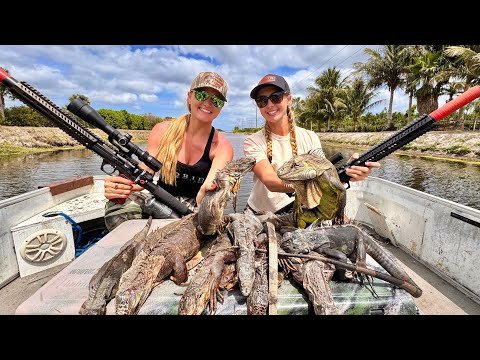
The short answer is that Kelly Young’s video is not just about shooting invasive iguanas. It is about the whole chain of work that comes with them: finding them in South Florida canals, making accurate shots from a moving boat, retrieving animals that try to disappear into water or rock, and then cleaning and cooking one to see what the meat is actually like. The hunt has plenty of action, but it also has a very clear practical purpose. These are animals the crew describes as damaging canal banks and nesting into places that can collapse over time, so the video keeps circling back to the same idea: this is hunting, but it is also removal.
That framing helps the video land as more than a highlight reel. The crew is having fun, but they are also doing work. The result is a companion story that feels closer to field notes than a standard hunt recap.
Air rifles, boat movement, and the challenge of a head shot
One of the clearest takeaways from the video is that this style of iguana hunting depends on precision. The crew uses air rifles, and Gerard walks everyone through the basics before the hunt starts: how the guns are made safe, how the safety works, and why the goal is to keep shots disciplined. The most repeated instruction is also the simplest one. Head shots are the priority.
That emphasis makes sense once the hunt gets underway. The boat is moving, the canal banks are uneven, and the iguanas are often half-hidden or already alert to the sound of the approach. Kelly keeps pointing out how the animals react fast and how easy it is to send a pellet just off target when the boat shifts. A few times, the difference between a clean hit and a miss comes down to timing, angle, and whether the iguana turns right before the shot.
The video also makes clear that a clean hit does not always mean an immediate end. Several iguanas keep moving after being shot, and more than once the crew has to call for another shot or wait for Rogue to retrieve one that has fallen into the water. That reality gives the hunt a certain tension. It is not a tidy one-shot setup. It is a chase across unstable footing, shallow water, rock edges, and canal debris.
What makes these iguanas a problem in the canals
Kelly does give the audience a straightforward reason for the hunt: invasive iguanas can burrow into canal banks, under sidewalks, and beneath bridges. Over time, that kind of digging can cause collapse. The video never tries to turn that into a lecture, but it does use it as the backbone of the day. The crew is clearly enjoying the hunt, yet the problem they are addressing is real within the world of the video.
That matters because it changes the tone of the whole piece. This is not a trophy-focused outing. It is closer to a working hunt in a place where the landscape itself is part of the issue. The banks matter. The holes matter. The water matters. Even the rocks and pipes become part of the story because they shape where the iguanas live and where the crew can safely shoot, retrieve, or lose an animal.
The canal setting also makes the hunt feel especially Florida. Murky water, concrete edges, overhanging structures, and fish and reptiles sharing the same narrow corridors all show up in the background. Kelly keeps the focus on the animal work, but the setting quietly explains why the whole operation is so awkward and why accuracy matters so much.
The dog work that keeps the hunt moving
Rogue is one of the most memorable parts of the video because she is not just along for the ride. She is part of the retrieval system. Several times, once an iguana is down, Rogue is sent to bring it back before it disappears into water or slips into a hole. Kelly and the crew talk to her like a partner, and the video keeps rewarding that setup by showing how useful she is when a shot lands in a bad spot.
The retrieval work becomes even more important when the hunt gets messy. Some animals fall in deeper water. Some roll. Some kick hard enough to keep moving after being hit. In those moments, the dog’s job is to close the gap between the shot and the recovery. The video gives that work real weight without overexplaining it. You can see the difference between a successful retrieve and the frustration of watching a wounded iguana drift toward cover.
There is also a comic edge to it. Kelly jokes repeatedly that the dog is doing all the work, and Rogue’s reactions give the hunt a little rhythm. The boat crew is clearly in a good mood, but the retrieval job keeps the pace from stalling.
Eggs, field care, and what the meat was actually like
The most unusual turn in the video comes after the hunt, when Kelly shifts from field handling to food prep. One of the iguanas has eggs inside, and the video shows them clearly the next day after cleaning. Kelly points out that the eggs were in casing and says they would have been laid soon. The eggs are large enough to be surprising, and the video spends time on that because it was not what Kelly expected.
That section of the video matters because it turns the hunt into a more complete picture of the animal. The hunt is not just about taking an invasive species off the bank. It is also about what is inside the animal, what stage it is in, and how the meat and eggs look once the animal is processed. Kelly also talks through the skinning process in a way that feels genuinely exploratory. This is the first time he has skinned an iguana, and the narration stays honest about that learning curve.
The meat itself gets a fair test. Kelly seasons the pieces, smokes them, and then tastes both leg and tail meat the following day. His reaction is not theatrical. He says it tastes good, with the tail meat coming across a little better to him than the leg. He also describes the flavor in familiar terms, comparing one part to crab-like notes with a chicken feel and saying the meat would work with barbecue sauce. That kind of comment grounds the whole experiment. It is not presented as some exotic stunt. It is treated like an actual meal.
A hunt that turned into dinner and a cleanup lesson
By the end of the video, the story has moved through three distinct phases: hunt, recovery, and cook. That is what gives it shape. The opening boat work and rifle shots are only part of the point. The retrievals, the close calls, the egg inspection, and the skinning all build toward the same conclusion that Kelly reaches on camera: iguana can be good to eat, and the process is manageable once you know what you are looking at.
The video also keeps a lighter, more personal feel because Kelly never pretends to be doing everything perfectly. He talks through misses, shifting footing, and the awkwardness of reaching into holes or dealing with muddy water. That honesty makes the feature stronger. The day feels lived in, not staged.
For viewers who came for Florida iguana hunting, the clip delivers the expected action. For anyone curious about what happens after the shot, it offers the more interesting part: the work of retrieving, cleaning, and deciding whether the animal is worth cooking. In Kelly Young’s version, the answer is yes.
Watch the original video: https://www.youtube.com/watch?v=6JFKUpvJlbY
RECOMMENDATIONS
All About The Life designs from Texas Thread Theory, inspired by the places you go and the stories you bring back.
Life Happens Out There
An outdoor-focused AATL design celebrating mountains, forests, hiking, camping, road trips, and the simple idea that life happens when you get out there and explore.