The Ecuador coast trip starts with town-hopping, not one fixed base
The simplest answer to what is happening in this video is that Kelly Young is tracing Ecuador’s Pacific coast in a loose, exploratory way, moving from one seaside stop to the next and letting the trip build as it goes. It is part road trip, part food run, part wildlife outing, and part surf check. That structure matters, because the video does not lean on a single destination or a single payoff. Instead, it keeps widening the frame until the island excursion gives the whole trip a new center of gravity.
This is also Kelly’s first time in Ecuador, which gives the footage a very open-ended feel. Rather than presenting the coast as a polished itinerary, the video moves the way an actual unfamiliar trip often does: rent a car, follow the shoreline, stop when something looks worth seeing, and adjust when the waves, the tides, or the day itself decide something else.
Ayangue, Ayampe and the rhythm of the surf towns
The early part of the trip is all about the coast itself. Ayangue is a quick stop, but even in that short visit the video makes one thing clear: the seafood on this stretch of Ecuador feels like a major part of the experience. Fresh shrimp, fish and lobster are described as especially good, and the presence of fishing and shrimp farming gives the food context beyond just being a nice meal on the road.
Ayampe, by contrast, comes across as a place to slow down. Kelly describes it as peaceful, quiet and safe, with a surf-town atmosphere that is more restful than rowdy. It is not presented as the kind of stop that begs to be stretched out forever. In fact, the video hints that one night might have been enough. But the calm of Ayampe also helps define the trip’s pacing: the coast is being experienced town by town, with each place offering a different version of the same shoreline.
Surfing runs through this whole section, too, even when the waves are not cooperating. Kelly and Caleb keep looking for better breaks, and that search adds a useful reality check to the trip. The coast is scenic, but it is not perfectly staged for the camera. Conditions matter, tides matter, and the best plan is often to keep driving until the day gives you something better.
Why Isla de la Plata becomes the center of the trip
The trip changes once the boat leaves the mainland for Isla de la Plata. Kelly frames it as a smaller, closer, less expensive kind of island outing compared with the Galápagos, which is why the island gets called the poor man’s Galápagos. That comparison is useful, but the video is careful not to oversell it. The island is not presented as a substitute for the Galápagos so much as a different kind of wildlife stop: more reachable, less grand in scale, but still packed with memorable encounters.
The journey itself adds to the feeling. A boat ride of roughly an hour and a half takes the group out to the island, and the video makes room for the anticipation of spotting whales along the way. Once they arrive, the day becomes a mix of beach landing, wildlife watching, a hike and later snorkel time. It is a tourist excursion, yes, but one that still feels physical and a little unpredictable.
There are small details that make the island feel lived in rather than packaged. Red crabs on the beach, sea turtles near the boats, and the mention of old PVC pipes used to deal with invasive rats all help the island feel like a place with real ecological pressures, not just a postcard stop. The video stays close to what the group sees and hears, which gives the island segment a sense of texture.
Blue-footed boobies, nesting birds and the island’s quieter surprises
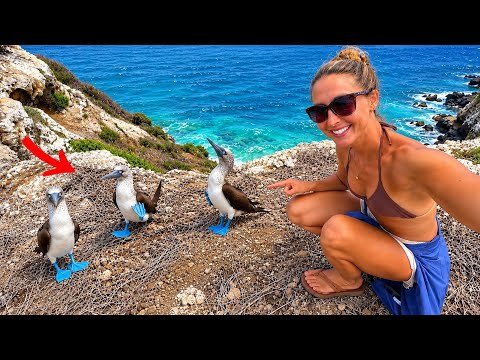
The emotional peak of the video is not difficult to identify. It is the blue-footed boobies.
Kelly’s reaction makes that clear almost immediately. The birds are close, calm and easy to observe on foot, and the footage turns from general sightseeing into a much more specific wildlife moment. The male’s courtship behavior is especially striking: dancing, presenting grass, and showing off the vivid blue feet that make the species so recognizable. That sequence becomes the trip’s standout because it feels personal and unforced. Kelly is not standing behind a fence or watching from far away. The birds are simply there, on the ground and in the open, while the group moves quietly around them.
The island also introduces other birdlife, including Nazca boobies and younger chicks. That detail matters because it broadens the scene beyond the famous blue-footed birds. The island is not just one signature species in a vacuum. It is a nesting site where different birds occupy different areas, and where age, color and behavior all become part of what the viewer is seeing.
Kelly’s reaction says as much as any guidebook could. The birds are the kind of thing she could have stayed with all day, taking photos and videos without needing anything else to happen. That’s the real reason the island segment lands: it gives the trip a quiet, close-range encounter that feels more memorable than a bigger, busier spectacle might have been.
Back on the mainland: Puerto López, fish markets and the last stretch south
After the island, the mainland feels like a reset. Puerto López appears as a practical stopover, with a good Airbnb, a wave check that does not promise much for surfing, and a local fish market that Kelly clearly enjoys. That market sequence is one of the most revealing parts of the video because it shows what she is drawn to in Latin American travel generally: not just scenery, but the everyday working spaces where food and local routines are visible.
The market gives the trip a grounded finish. Fish laid out for sale, unfamiliar varieties, and the simple pleasure of walking through a place where the morning catch has just come in all help balance the more famous wildlife footage from the island. Even when Kelly and Caleb are buying something small to eat and moving on, the video keeps paying attention to the rhythm of local life.
The last section of the trip slows down again near Montañita and Olón, where the creators stay in a beach bungalow and spend the final days working around the weather, the surfing, and Kelly’s brief stretch of not feeling well. That part of the video is less about a single big event and more about winding the trip down naturally. They still manage a dinner on the beach and a few more sunsets, which feels like the right kind of ending for a coast-hopping Ecuador travel log.
What the video leaves you with
What makes this Ecuador Pacific Coast road trip work is that it never tries to be one thing. It is a surf search, a seafood tour, a wildlife outing and a loose road trip all at once. The towns give the route its shape, but Isla de la Plata gives it its memory. By the end, the coast is not just a string of place names. It is a stretch of shoreline defined by quiet surf towns, fresh food, a boat ride offshore and a close look at blue-footed boobies in the wild.
For viewers, that balance is the appeal. The trip feels real because some parts are relaxed, some are uncertain, and some are simply about being in the right place when the birds do what they do.
Watch the original video: https://www.youtube.com/watch?v=pY64G5vQygA
RECOMMENDATIONS
All About The Life designs from Texas Thread Theory, inspired by the places you go and the stories you bring back.

Go Somewhere — Life Is Better On The Road
A bold road-trip design featuring an RV, winding road, mountains, lake scenery, and the message “Go Somewhere — Life Is Better On The Road.” Made for travelers, campers, RVers, and anyone who feels a little more like themselves once the highway opens up ahead.