The simplest answer: the system kept the HiAce moving
The clearest way to read this video is as a field test of redundancy, not a showroom-style product tour. The team took a Toyota HiAce 4x4 into remote country around Lake Campion Nature Reserve and deliberately ran it with the alternator disconnected. The idea was straightforward: if the alternator failed, could the vehicle still keep going, keep the fridges alive, and keep the basic camp systems functioning without turning the trip into a recovery mission?
The answer, based on what the video shows, is yes. Over several days, the HiAce ran on a combination of solar input and battery reserve, with the Egon 48V architecture handling both vehicle needs and house loads. The key point is not that the alternator became irrelevant in every situation, but that its absence was treated as a manageable inconvenience rather than an immediate trip-ender.
Why the team chose to test it this way
This was not a casual drive with a few instruments watching along in the background. The whole point was to prove the built-in redundancies of the 48V system in real conditions. That is why the alternator was disconnected from the start of the trip and left that way through the drive. The crew wanted to see what happened on cloudy days, in mixed driving, and while the van was also supporting normal camp life.
The video makes that process feel practical rather than theatrical. The crew checks the battery state, watches solar input, talks through the alternator being dead, and keeps comparing what is being used against what is being generated. That matters because the test is not simply about whether one component works. It is about whether the whole electrical system behaves sensibly when a major charging source is removed.
What the solar numbers suggest about the setup
One of the strongest parts of the video is how often the crew returns to the actual numbers on the display. Early in the trip, they note solar output in the hundreds of watts even under cloudy conditions, with the panels still pulling meaningful charge as the weather shifts. Later, the system is described as producing 758 watts over one hour of driving in a mostly cloudy stretch, and on another day the team records 3.15 kWh of energy produced.
Those figures matter because they show the setup working as a system, not just as a single panel array. The build uses four 200W high-voltage Amptron panels, and the video repeatedly links the strong solar result to the decision to use higher-voltage panels and a 48V charging architecture. The basic idea, as explained in the video, is that a higher operating voltage helps reduce losses and improves charging efficiency.
There is also a useful comparison made to alternator charging. The crew suggests that the amount of energy produced by the solar array over a day would take the alternator just under 40 minutes to replace under normal conditions. That is the kind of comparison that helps explain why the test matters. It is not just about whether the batteries survive. It is about whether solar and storage are strong enough to carry the trip’s real-world loads for long stretches.
How the DC hub Nano changes the way a vehicle is wired
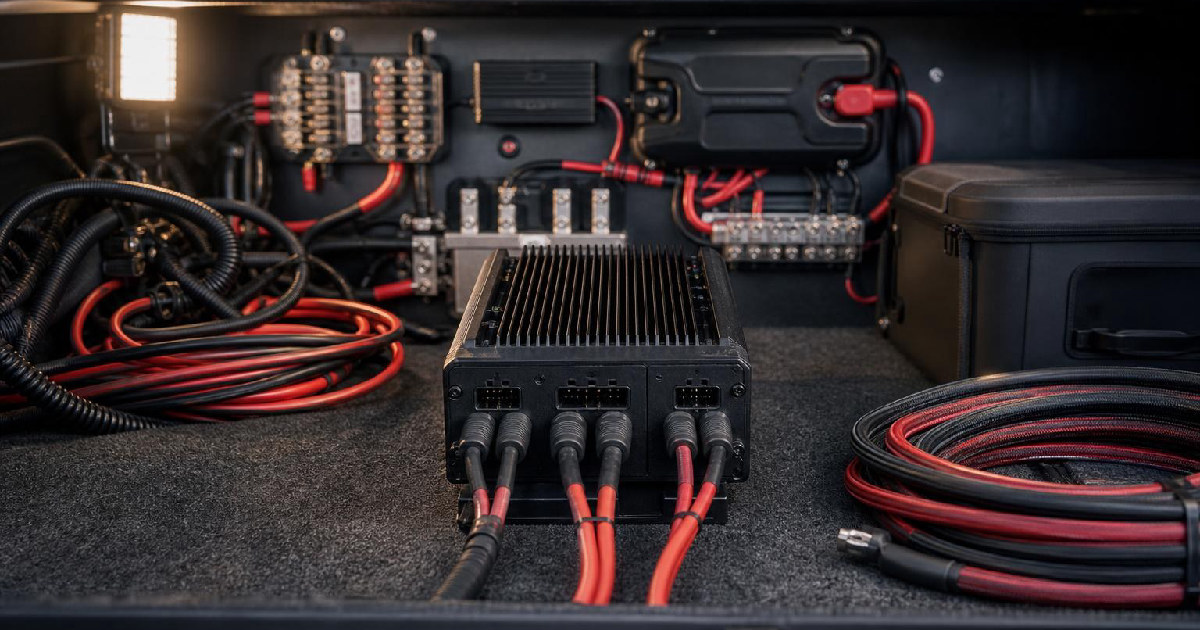
The video also spends time on the Egon DC Hub Nano, and that part of the build is easy to overlook if you focus only on the alternator test. But the Nano sits at the center of the broader story because it reflects the kind of packaging challenge that comes up in compact vehicles. The creators explain that the original DC Hub concept was useful, but sometimes too spread out for tighter spaces such as SUVs and campers.
The Nano is presented as a compact central unit for DC electrical distribution. In the video’s telling, that means fewer scattered components, a neater layout, and a more standardized way to build the system in different vehicles. There is also a strong claim embedded in the presentation: the traditional way of wiring DC electrical systems is being replaced by a simpler, more centralized approach that relies less on complicated layout work.
What stands out here is less the sales pitch and more the logic behind it. In a remote overland build, wiring is not abstract. It affects serviceability, fault finding, and how quickly a trip can recover from a problem. The crew leans into that by showing how the alternator can be isolated through a plug and then reintroduced later, without turning the setup into a major teardown.
The road trip side of the test mattered too
This could have been a static workshop demonstration, but it is much more convincing because it happens while the van is actually traveling. The route includes remote tracks, old mine areas, muddy sections, fuel stops, and camps in quiet woodland country. That is important because a system that performs well in a parked demo is not the same as one that supports a moving vehicle with fridges, air conditioning, cooking, lights, and overnight loads.
The crew is honest about the conditions too. The day starts cloudy, which makes the test harder and more interesting. Later, the battery is drawn down overnight because they intentionally leave systems running: inverter, hot water, induction cooking, fridges, and Starlink. That kind of use gives the test some weight. They are not protecting the batteries just to preserve a neat number on the screen; they are trying to see how the system behaves when camp life is left fully on.
There is a nice tension in that approach. On one hand, the alternator is disconnected. On the other, the crew still behaves as if the van is being used normally. That is exactly why the results feel meaningful. They are testing not only a technical setup, but a travel pattern.
What the final reconnect proved
Near the end of the video, the alternator is reconnected and the charging response is shown very quickly. The crew notes that the battery is around 25% at that point and then watches the charge rate jump dramatically once the engine is running again. They describe a high-idle charge rate of around 4.5 kW and estimate that the battery could move from roughly 25% to near full in about 45 minutes.
That contrast is the real takeaway. Solar alone was enough to keep the trip moving, and enough to support the loads they chose to run. The alternator, when returned to the system, still did what alternators do best: it refilled the battery quickly. But the point of the test was never to argue that alternators are obsolete. It was to show that a properly designed 48V setup can make an alternator failure something you work around rather than panic over.
That is a useful distinction for anyone thinking about remote travel. Redundancy is not about pretending failures will never happen. It is about making sure the trip still has options when they do.
Why this video works as a companion to the build
The strongest thing about the feature is that it treats the electrical system as part of a larger overland life, not a lab object. The bird calls, the mud, the camps, the mine ruins, the quiet roads, and the cooking all help anchor the technical test in a lived-in trip. The result is a clear demonstration of what the HiAce build is aiming for: a vehicle that can keep going even when one of the usual charging pillars is removed.
For viewers trying to understand the value of the Egon 48V architecture, that is the real answer. It is not just about big solar numbers or a clever hub on a wall. It is about a remote travel setup that keeps the essentials working while the crew continues with the trip.
Watch the original video: https://www.youtube.com/watch?v=j12ISWzayEo
RECOMMENDATIONS
All About The Life designs from Texas Thread Theory, inspired by the places you go and the stories you bring back.

Do More Things. You’ll Have Better Stories.
An AATL design for people who know the best stories come from getting out and doing more. Built around adventure, travel, road trips, outdoor experiences, and weekends worth remembering.