The small rigging change that clarified the whole day
This Fisherman’s Life salmon outing is really about one practical discovery: a simple bait-rigging adjustment that makes the spin more consistent every time. After three days on the water, the crew finally lands on a way to rig the cable baiter so the anchovy tracks in a tight, clean torpedo shape. That matters because the whole session is built around repeatability. If the bait is doing the same thing every drop, the anglers can focus on positioning, speed, and getting back in the water instead of wondering whether the bait is behaving.
The video’s wider story is equally straightforward. Day three brings in a guest, Master June from More Than Fishing, and the timing is tight. The weather is set to turn rough, the window to fish is short, and the trip has an extra layer of pressure because June has flown up from Los Angeles for the only available day. The salmon are not just the goal for the video; they are also tied to a birthday promise, which gives the whole outing a sense of urgency without turning it into a drama.
Why the crew leaned on deep six divers
One of the most useful parts of the episode is how plainly the gear choice is discussed. The crew talks through several ways to troll for salmon, including deep six divers, cable releases, and downriggers, with mooching mentioned as well. In this session, the deep six diver stands out because it gets the bait down without needing a downrigger weight. That keeps the setup simple and gives anglers a way to fish for salmon even if they do not have the more specialized hardware on board.
That simplicity is a recurring theme. The crew likes that the deep six can be dropped, fished, and reset quickly. If a bait needs replacing, they can put another one on and send it back down. The video does not present the deep six as some miracle tool; it presents it as a practical option that lets the day keep moving.
The bait spread also stays focused. The crew uses a cable baiter setup, a watermelon triangle flasher on one rod, and straight bait on another. Later, the conversation shifts toward smaller cable baiters because they sometimes spin faster. That detail connects directly back to the day’s main discovery: when bait is spinning the right way, the anglers feel more confident that it is working for them.
What the video suggests about bait spin and trolling speed
The clearest learning moment comes when the crew talks through the rigging itself. The anchovy is pinned on the right side near the top, then bent downward and toward the same side where the hook is inserted. The point is to use the hook pressure against the body so the bait takes on that torpedo-like spin instead of wandering or flopping. In the creator’s own framing, that is the part that finally made sense after days of fishing.
The speed discussion is just as practical. The crew is not creeping along at a crawl. They note that trolling speed matters, but they also suggest that salmon are fast enough to eat a bait moving at a good clip. The idea is not to baby the presentation; it is to keep the bait spinning cleanly and let the fish decide. That is a useful way to think about it because it shifts the emphasis from a nervous, ultra-fine adjustment mindset to a more confident one: if the bait looks right, the odds feel better.
That confidence shows up again and again in the dialogue. The anglers keep checking the bait’s action, and when it looks right, they treat that as a sign they are in business. The lesson is less about a secret formula and more about learning a dependable rig that removes guesswork.
Reading the bite, the birds, and the moving fleet
The day is not just about setup. It is also about reading water, signs, and other boats. Birds repeatedly factor into the decisions, and the crew uses them as a reason to shift position and troll where life looks more concentrated. That is standard salmon-fishing thinking, but the video makes it feel immediate rather than theoretical. When birds are working and the fleet starts moving, the anglers respond.
The crew also talks through the timing of the bite in relation to the tide. Over the three days, the hot window keeps shifting a bit, but the strongest action seems to sit roughly two hours before the tide change rather than exactly on it. That is not presented as a universal rule. It is just what this particular stretch of fishing looked like over these specific days, which keeps the observation grounded.
There is also a practical side to staying mobile. The boat moves from one area to another, circles back when birds show, and keeps lines in the water whenever possible. The video makes clear that the crew is trying to capitalize on the action while it lasts. When the bite is hot, there is no reason to treat the day slowly.
What the day produced at Martin’s Beach
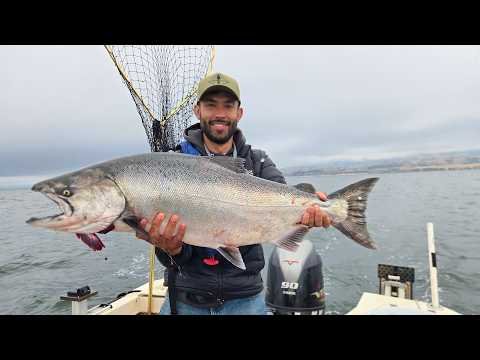
By the end of the session, the crew has put together a strong day on the water. They land multiple good salmon, including some that are described as thick, heavy fish. The footage keeps returning to the same pattern: fish on, netting struggles, quick resets, and then back to fishing. That rhythm matters because it shows how the rigging lesson fits into a bigger outcome. A bait that spins right is useful only if it helps the crew stay in the game long enough to capitalize when the fish are there.
The location is also part of the story. The fishing happens just north of Martin’s Beach, in roughly 80 to 110 feet of water, and the creator closes by saying the area is no longer much of a secret. That is not a complaint so much as a realistic note: when fish are there and word gets around, more boats show up. The session has the feel of a productive spot that is already busy enough to demand attention.
There is one more detail that gives the feature its shape. The creator notes that this is the last salmon run he can make for the season, so the days on the water are being used to learn, fill limits, and get as much out of the opportunity as possible. That makes the rigging breakthrough feel less like a gimmick and more like a useful finish to a stretch of fishing that has been building for several days.
For readers who want the practical version, the takeaway is simple: the bait matters, the spin matters, and the deep six diver keeps the system accessible. For viewers, the value is in seeing that lesson tested in real time, with fast action, a moving fleet, and enough pressure to show what works when the fish finally turn on.
Watch the original video: https://www.youtube.com/watch?v=PLcF33q57cs
RECOMMENDATIONS
All About The Life designs from Texas Thread Theory, inspired by the places you go and the stories you bring back.

Make A Story Worth Telling
A scenic vintage-inspired design that encourages you to “Make A Story Worth Telling.” Mountains, water, sunset, and tropical details give it an adventurous feel that’s perfect for travelers, explorers, and anyone who wants a life filled with moments worth remembering.