Why this hunt was really about decisions
The clearest read on this backcountry mule deer hunt is simple: Janis Putelis does not win it by locking onto one spot and hoping. He wins it by making a series of smart adjustments in steep country where pressure, distance, and patience all matter. The video is built around that idea. He starts with a backpack-in approach, commits to sleeping high, and keeps working through terrain that looks good for deer but is also clearly shared with other hunters.
That’s the tension running through the whole hunt. It is not just about finding mule deer. It is about finding the right mule deer in the right place at the right time, while avoiding a bunch of other people doing the same thing. Janis keeps reminding himself that the country is big, the deer are there, and the challenge is turning access into an actual opportunity.
Glassing, pressure, and the long wait for one buck
A lot of the hunt is spent doing the part of mountain hunting that looks quiet from the outside: glassing from knobs, checking drainages, and trying to make sense of movement that starts and stops over long stretches of time. Janis talks through how mule deer use steep aspen draws, brushy north-facing slopes, and the kind of country that seems obvious once you understand it, but still takes real patience to search properly.
The video makes an especially strong case for time spent on glass. Janis sees hunters, hears shots, watches deer count creep upward, and still doesn’t see the mature buck he wants at first. That’s the reality of hunting big public land country. There can be plenty of sign, plenty of habitat, and still no immediate payoff. The hunt keeps asking him to resist the urge to panic or move just because things feel slow.
He also keeps reading the other side of the equation: hunting pressure. When trailheads show more trucks, when he spots other hunters, or when elk season overlap adds uncertainty, the hunt becomes less about simply being in good country and more about finding a place that other people don’t want to go. That pressure shapes every decision that follows.
Why leaving a good spot mattered
One of the most useful parts of the video is Janis’s willingness to leave a place that looks promising but isn’t yet producing the right deer. He gets into the kind of internal debate every backcountry hunter knows: stay or go, keep looking or move on, wait it out or switch basins. Instead of turning that into a dramatic speech, he treats it like a practical problem.
That matters because the hunt does not reward stubbornness for its own sake. After sitting through early glassing efforts and seeing only limited deer movement, Janis relocates and eventually pushes into tougher, less comfortable country without a trail. The move is messy, slow, and frustrating in the moment, but it becomes the turning point. The video suggests a simple truth: in big country, better decisions often look like more work before they look like progress.
There is also a useful lesson in how he evaluates the landscape. He is not trying to count deer for sport. He is trying to locate a buck that makes him stop and say “ooh” on first glance. That standard keeps him from settling and gives the hunt a clear filter. It is not about antler math. It is about recognition.
The stalk that turned observation into opportunity
Once Janis spots the buck he wants, the hunt shifts from glassing to solving a terrain puzzle. He uses OnX to mark the deer’s location, then works out how to approach from a ridge that gives him a better shooting lane. That sequence is important because the stalk is not treated as a gamble; it is treated as a controlled approach built on distance, angle, and patience.
What stands out here is how much of the stalk happens before any shot is even possible. Janis drops elevation, climbs again, and keeps adjusting until he can set up with a clearer lane and a more realistic distance. He is honest about the time it takes, the steepness of the climb, and the fact that he is burning daylight to get into position. That honesty gives the stalk real texture. It isn’t a heroic montage. It is a lot of hard walking in thin air with one chance in mind.
Then comes the hardest part: waiting. The buck beds. Does feed. Other deer move. The light keeps changing. Janis is close enough to watch behavior, but not close enough to take a clean shot at first. The video does a good job of showing the tension in that space. A stalk is one thing. A shot on a bedded buck in broken cover is something else entirely.
What the recovery and rifle check add to the story
The buck eventually comes back into a shootable situation, and Janis gets the job done. But the video does not end there, and that’s part of why it feels like a real hunting story instead of just a victory lap. He reflects on the buck’s color, the steep country, the long hike, and the physical toll of living out of a tent for several days. He also talks about gratitude in a way that feels earned rather than polished.
That gratitude is rooted in the realities of the hunt. He acknowledges public land access, the people who support his time in the field, and the wildlife management that makes this kind of hunt possible. Those aren’t throwaway lines here. They fit the tone of a trip that has been all about working within the limits of the landscape and respecting the opportunities it offers.
The post-hunt rifle check is another smart closing note. After wondering why his shots landed right of where he aimed, Janis returns to the bench and verifies that the rifle is still shooting where it should. That does two things. First, it keeps the story grounded in process rather than guesswork. Second, it shows that a field result does not always mean the equipment failed. Sometimes the mountain, the body position, the wind, or the shot itself creates the error.
Why this mountain mule deer story lands
What makes this hunt worth watching is not just the outcome. It is the way Janis keeps working the problem. He moves when the country is slow. He stays patient when deer appear but not the right buck. He pushes into tougher terrain when that seems like the better way to escape pressure. And when the buck finally appears, he does not rush the process.
That combination—patience, terrain reading, and a willingness to do the hard walk—pretty much defines this backcountry mule deer hunt. It is a reminder that success in the mountains often comes from staying mentally flexible long before it comes from pulling the trigger.
Watch the original video: https://www.youtube.com/watch?v=oAnhO_XBZKc
RECOMMENDATIONS
All About The Life designs from Texas Thread Theory, inspired by the places you go and the stories you bring back.
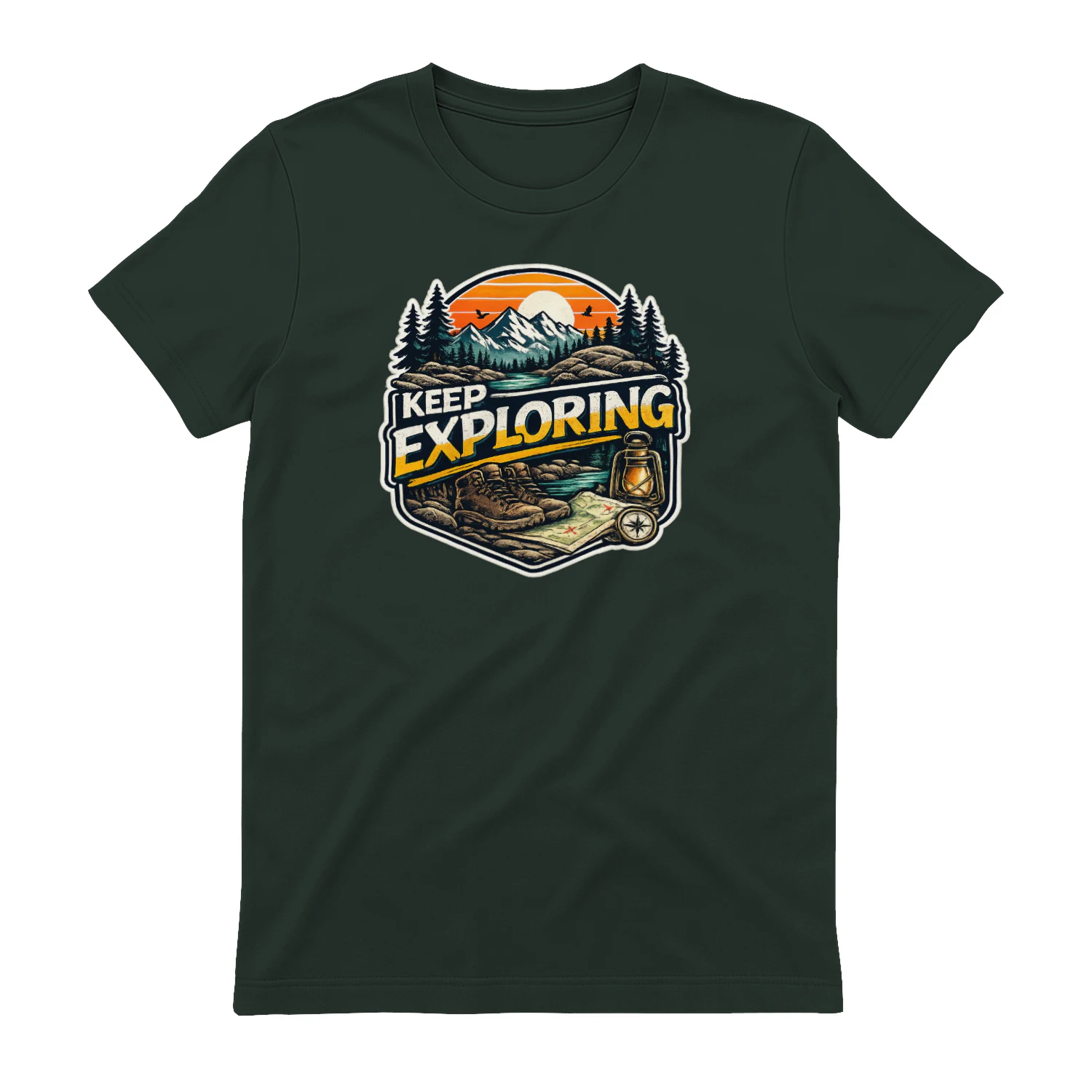
Keep Exploring Badge
A vintage outdoor badge centered on one simple message: “Keep Exploring.” With mountains, evergreens, a river, hiking boots, lantern, map, and compass details, it’s made for hikers, campers, travelers, and anyone who is always curious about what’s around the next bend.