The farm is part kitchen, part family archive
The clearest answer to what this video is about is simple: Yia Vang’s Hmong family farm in Minnesota supplies ingredients for his restaurants. But that is only the practical layer. The larger story is about how a family farm can carry memory, identity, and responsibility at the same time. The produce matters, of course. So do the rows of peppers, chilies, herbs, eggplants, tomatoes, beets, watermelon, cucumbers, cantaloupes, and lemongrass. But the video keeps returning to the same idea: the farm is not only where food begins. It is where a family’s history keeps showing up in the present.
Vang describes the land as something shaped by his parents’ habits, work ethic, and refusal to give up on a patch of dirt just because it looks difficult. That perspective gives the farm a different kind of weight. It is not a hobby plot, and it is not simply a supply chain. It is a place where the family’s daily labor and long memory meet.
Why the vegetables matter less than the hands that grow them
The produce in the video is vivid because it is specific. There are peppers and chilies that will go to the restaurant, herbs and vegetables that feed different dishes, eggplants turned into a baba ganoush-like preparation, tomatoes used in multiple forms, and beets sitting right alongside the rest. There is lemongrass, described by Vang as something that smells almost like breakfast cereal when broken open. There are mustard greens that are fermented for the restaurant. Watermelons are such a central part of the farm that Vang jokes about preparing for “watermelon everything.”
Still, the video is not really trying to impress you with variety alone. It keeps coming back to who is doing the growing. Vang talks about his parents working from early morning into the afternoon, hand-weeding, planning seasons, and deciding what should be planted where. His mother and father are not background characters in the farm’s operation; they are the structure holding it together.
That matters because the farm is framed as a family system, not a corporate one. His parents ask what the restaurant needs. He asks for specific crops. The season unfolds as a conversation. Food here is less about sourcing and more about relationship.
A shed, a prep room, and a restaurant built from the same logic
One of the most revealing parts of the video is how seamlessly it moves from the farm to the shed to the restaurant prep spaces. Those places are separated physically, but the story treats them as extensions of one another.
The farm shed is not romanticized. It is a working lunch spot with plastic produce boxes for seats, a fire going, storage piled nearby, and buckets of water brought in for washing hands and produce. Yet Vang describes it with genuine affection because it reflects how the family actually lives and works. It resembles the kind of improvised communal space he connects to old Hmong villages in Laos: practical, communal, and built from whatever is available.
That same improvisational logic carries into the restaurant. The back-of-house areas hold brined chops, cured ribs, sauces, dry storage, a heavy mixer, and a grill that becomes the center of production. Vang talks about the open kitchen as a deliberate choice because he wants diners to stay connected to the people making the food. In other words, the restaurant is not trying to hide the farm story. It is trying to extend it.
The video also makes a point of the objects that bridge those spaces: cinder blocks, wood fires, hand labeling, a family table, and even the produce buckets used to move crops from the farm to the restaurant. That is the real design language of the piece. Not decorative polish, but continuity.
The wall of photographs turns the meal into memory
If the farm is where ingredients grow, the restaurant wall is where the backstory becomes visible. The photographs are not used as decoration for atmosphere. They are there to explain why the restaurant exists at all.
Vang points to pictures of his parents, old family images, immigration photos, military history, and moments that mark major passages through Hmong refugee life. The video spends time here because the photos do what a menu alone cannot do: they show the human chain behind the food.
The tape recorder is one of the most affecting details in the story. It represents a time when family members could not simply pick up the phone and call one another, so voices were recorded and sent across distance. That detail lands because it shows how much of the family’s history had to survive through fragile means. The restaurant, in this framing, becomes another kind of record-keeping. Not a museum, but a living place where memory is part of service.
Vang also connects the restaurant’s design back to refugee homes and to the feeling his mother had when she recognized the roofline in the building. Those moments matter because they make the restaurant feel less like a departure from the farm and more like an extension of home.
What the video says about inheritance, not just ambition
The most useful way to read this companion to the video is as a story about inheritance. Vang is a chef with awards and a growing public profile, but the video repeatedly undercuts the idea that success is the main point. What matters more is what he inherited: his parents’ labor, their survival, their way of eating, and their insistence on making use of what the land gives.
That is why the video keeps returning to war, flight, and resettlement. Vang explains that his father was a child farmer who became a soldier, that the family history runs through Laos, Thailand, and the refugee camp where his parents met, and that the move to the United States created the space for a different future. The restaurant, then, is not just a business milestone. It is evidence that the future his parents hoped for actually happened.
There is also a quiet but important idea running through the whole feature: peace can still look like work. The parents who farmed as children, survived war, and raised a family in the United States are still up before dawn, still weeding, still carrying water, still asking what the restaurant needs. Vang does not treat that as quaint. He treats it as love in action.
That is what gives the video its shape. The land is productive, but it is also personal. The food is delicious, but it is also historical. And the restaurant is successful, but it is also a way of answering a family story that started long before any dining room existed.
Watch the original video: https://www.youtube.com/watch?v=DXOOSoFrQtc
RECOMMENDATIONS
All About The Life designs from Texas Thread Theory, inspired by the places you go and the stories you bring back.
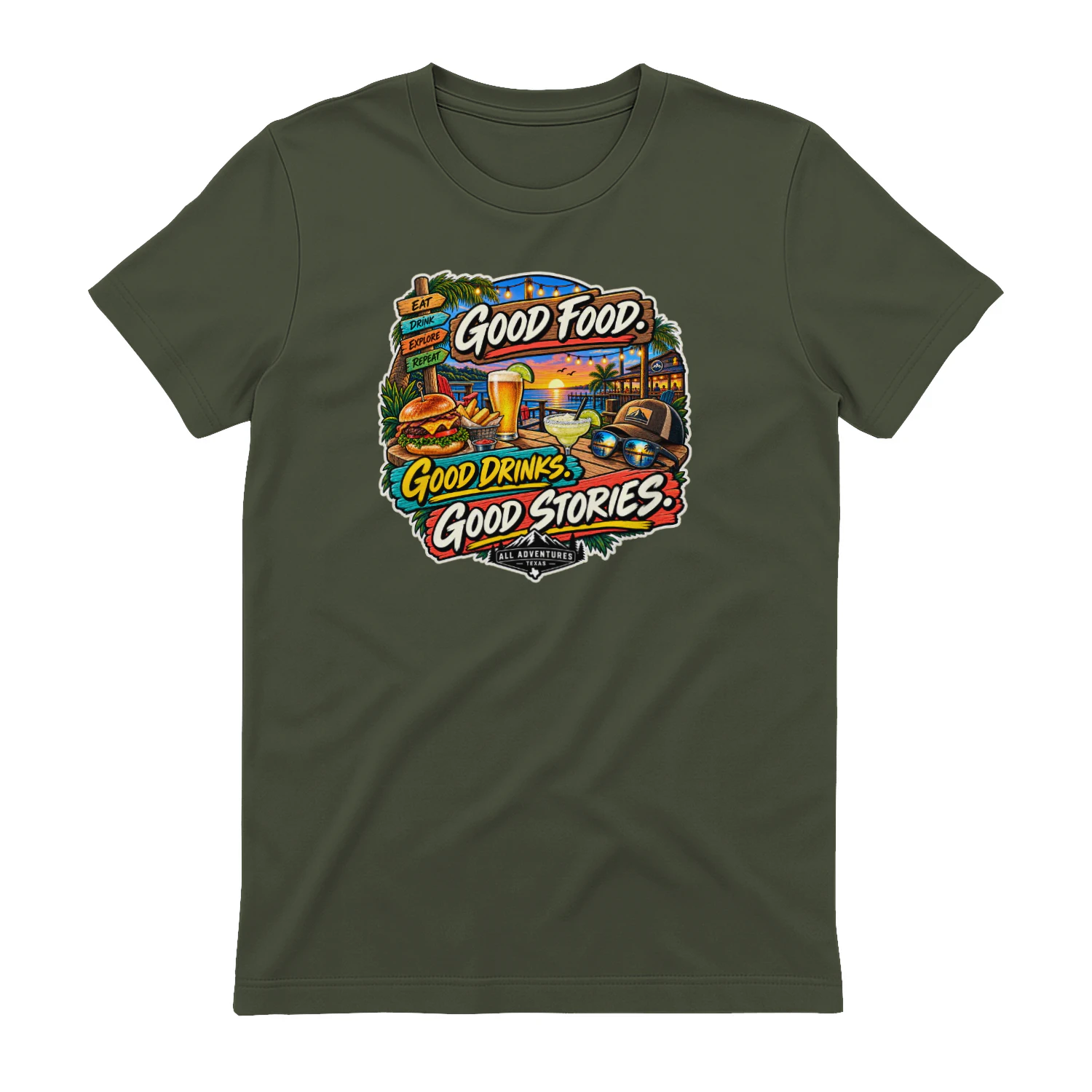
Good Food. Good Drinks. Good Stories.
A vintage-inspired food and nightlife design celebrating three things that make a night worth remembering: “Good Food. Good Drinks. Good Stories.” Perfect for restaurant lovers, cocktail fans, travelers, foodies, and anyone who believes the best experiences are even better when shared.