Why this Amarillo stop mattered beyond a place to park
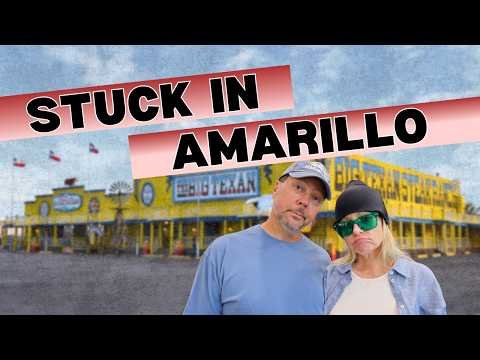
The direct answer to what happens in this video is pretty straightforward: the crew reaches the Big Texan RV Ranch in Amarillo, uses the stop to check how the new RV is behaving, takes in a few roadside attractions, and then has to slow the whole plan down when a migraine changes the timetable. But the better way to read the episode is as a working travel day. This is not just an overnight on the map. It is a stop where weather, road feel, campground layout, tank setup, dinner plans, and health all collide in the same 24 hours.
That is what gives the video its shape. Amarillo becomes a place where the trip is measured in more than miles. It is also measured in how the rig handles a bumpy route, whether the new tank information holds up, how much the campground feels like a destination instead of a parking spot, and how quickly plans can be reshuffled when the body says no.
Route 66 weather, road feel, and the first arrival stress test
Before the park ever enters the frame, the travel itself is doing a lot of the talking. The crew is crossing stormy ground in Oklahoma and Texas country, watching weather systems sit off to the side of the route and deciding whether they can slip past the worst of it. That uneasy balance is familiar to anyone who has traveled long distances in an RV: the day is not just about arriving, but about arriving with the least amount of drama possible.
Even the road surface gets attention here. The video makes a point of how a small change in speed can make a noticeable difference on a rough cement road. It is a useful reminder that a tow setup can feel completely different depending on pace, not just pavement. That kind of observation does not sound glamorous, but it is the sort of practical knowledge that makes long travel days more manageable.
The arrival itself also has that mixed feeling of relief and caution. There are tight visual cues, sign lines, trailer swing to think about, and a careful attempt to line up the rig before settling in. It is the ordinary stress of a new place with a large setup, and the video lets that tension sit naturally instead of pretending it does not matter.
Using a new RV stay to verify tank capacity and water routing
One of the most useful parts of the stop is the systems check. The crew does not treat the campground like a passive break; they use it to learn the RV better. That includes testing the black tank and gray tank rather than simply trusting the label or a quick glance at the gauge.
The black tank test is especially direct. After dumping and resetting the meter, water is added while the gauge is watched closely. The crew keeps going until the toilet finally burps, which becomes the practical marker that the tank is truly full. That process leads them to the understanding that the black tank matches the listed 52-gallon spec.
The gray tank gets its own real-world test too. They close it, run water through the bathroom sink and shower, and watch how the system responds. When the shower stops draining and water starts backing up underfoot, the point is made clearly enough without needing much theory. By the end of the check, they have a working sense of where the water flows and how the tank behaves under load.
That is why this section matters. For RV owners, knowing what the tank is supposed to do is one thing. Seeing it behave in real time is another. The video turns that difference into an ordinary piece of travel maintenance instead of a chore.
What Big Texan RV Ranch actually offers off the road
Big Texan RV Ranch comes across as more than a basic overnight parking spot. The park has big pull-throughs, shaded areas, a pool, and a layout that includes both regular RV sites and more themed lodging. The video spends time looking at the Old West-style cabins and covered wagons, which gives the place a stronger identity than a typical roadside park.
That themed side is part of the appeal. The cabins and wagons are presented as the kind of setup that would be especially fun for families or kids, and the video lingers on the practical details too: the mini splits, the lofts, the bunk beds, and even the private bathhouse that comes with the wagon. It feels like a campground that knows it is also part roadside attraction.
There is also a sense that the park is built for travelers who are not just trying to sleep and go. The crew notes the big pull-throughs, the back-in sites, the propane, and the general convenience of being able to settle in without overcomplicating the stop. That makes the park feel like a decent fit for a moving day that already had enough going on.
Dinner at the steakhouse, then a quick look at Bug Ranch
The evening shifts from RV logistics to date-night energy at the Big Texan Steakhouse. The crew talks through the menu, the famous steak challenge, and the way the restaurant is tied to the park itself. Even without taking on the giant challenge, the meal becomes part of the stop’s identity. It is one of those places where the meal and the location are inseparable.
Right nearby, Bug Ranch adds another layer of roadside oddity. The video treats it as a playful take on Cadillac Ranch, with Volkswagen Beetles instead of the more familiar cars. That distinction matters because it tells you something about the spirit of the area: this is a stretch of Route 66 where the attractions are meant to be noticed, photographed, and remembered, even if you only spend a few minutes there.
There is no need to overstate the detour. Bug Ranch is not framed as a major destination. It is framed as the kind of curious stop that makes a road trip feel like a road trip.
When a migraine changes the itinerary
The most human turn in the video is the one no one planned. A migraine forces an extra day in Amarillo, and the travel schedule has to bend around it. That shift changes more than departure timing. It also changes the tone of the stop from active sightseeing to a quieter, slower day of waiting, resting, and canceling or moving plans.
The video does not try to dress that up. The crew has to call off a Harvest Host stay, book something else for the next night, and let the route settle into a new shape. It is a reminder that life on the road still has to make room for health, and that the best-laid route plans can be rewritten by a single bad day.
That honesty gives the episode a lot of its strength. It does not pretend every stop is smooth or every delay is exciting. Sometimes the smartest travel decision is simply to stay put.
The final weigh-out and the road west
Before leaving, they use Load IQ to weigh the RV in travel mode and get a sense of how the rig is sitting. The crew also addresses a comment they have seen about whether the system communicates outward, making clear that it does not have outside communication like Wi-Fi or Bluetooth. The point here is not a gadget review, but another example of how this stop doubles as a maintenance check.
By the end, Amarillo has served several jobs at once. It was a storm dodge. It was a systems test. It was dinner. It was a roadside curiosity stop. It was also a forced pause that kept the whole trip honest.
That may be the best summary of the Big Texan RV Ranch stop: it started as a place to sleep, and ended up telling the crew quite a bit about the RV, the road, and the pace they need to keep as they head west.
Watch the original video: https://www.youtube.com/watch?v=vRupAeKqlwo
RECOMMENDATIONS
All About The Life designs from Texas Thread Theory, inspired by the places you go and the stories you bring back.

More Trips. Better Stories.
A travel-inspired design built around a simple formula: “More Trips. Better Stories.” With vintage travel-stamp, airplane, compass, luggage, and mountain details, it’s perfect for frequent travelers, weekend wanderers, and anyone already thinking about where they want to go next.