The mission is simple until the country changes it
The plain answer to what this video is about is straightforward: 4WD 24-7 is trying to open a new four-wheel-drive route through the Kimberley to a secret, unnamed beach that no vehicle has reached before. But that simple mission does not stay simple for long. Once the crew hits the Oombi Track and then runs into flooding rain, the trip stops being a clean adventure story and becomes a practical test of recovery, judgment and patience.
That shift is really the heart of the episode. This is not a clean run to a destination. It is a convoy trying to keep moving through country that turns from dusty and remote into soaked, soft and punishing almost overnight. The result is a feature about what happens when a planned route meets a season that is clearly not following the plan.
Why the Oombi Track is the real test
The Oombi Track is presented as one of the crew’s favorite drives in Australia, but this trip uses it for something bigger than a scenic run. Halfway along, the crew turns off where there is no road and no sign, aiming for country that has not been opened up by four-wheel drive before. That matters because the mission is not just about getting from A to B; it is about finding out whether a line through the bush can even be made at all.
The early obstacle at Miaaka Flats makes that point immediately. The mud is not a side note here. It is the first gatekeeper. Vehicles either commit, use momentum, or stop dead. From the start, the episode shows how quickly remote travel can shift from controlled to uncertain. The convoy is heavy, loaded with fuel, water and spares, and even before the deeper floodplain problems begin, the conditions are already asking the drivers to choose their lines carefully.
That is where the video’s tension comes from. The drivers are not just crossing terrain; they are reading it in real time, adjusting tyre pressures, deciding when to keep moving and when to stop, and relying on one another to set up recovery points as they go.
The Durack River is only one part of the challenge
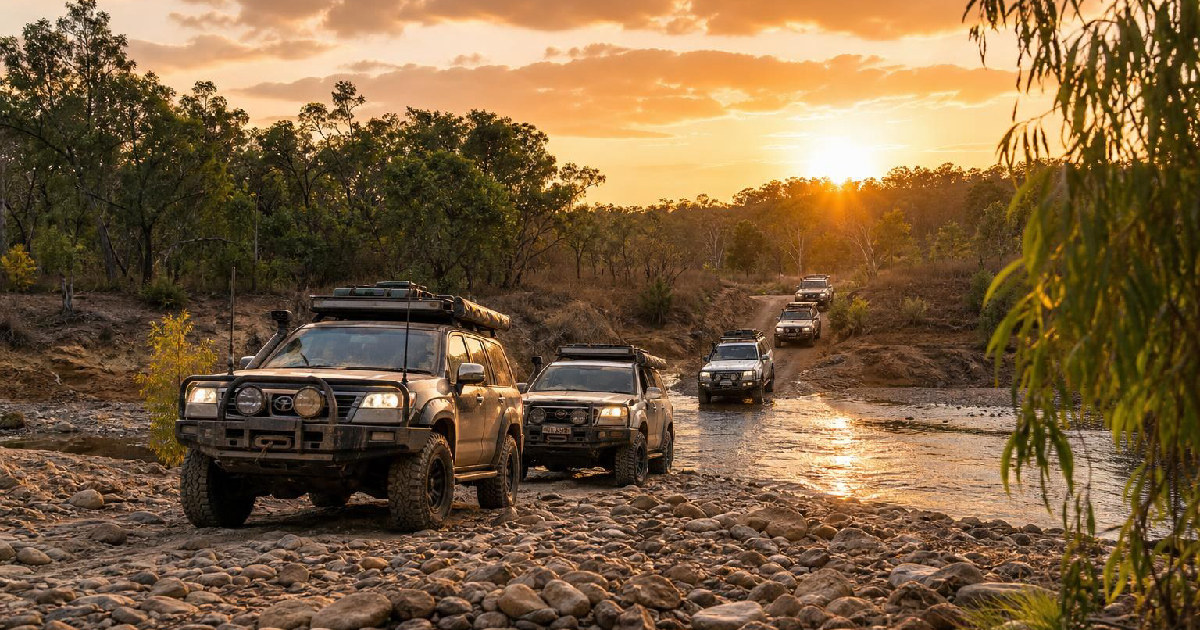
The Durack River crossing could easily have been the main event in another episode, and it is certainly a serious hurdle here. The river is full of boulders, hidden shifts in the bottom and the kind of uncertainty that makes even experienced drivers hesitate. The crew treats it like a proper technical crossing: vehicles are staged, a recovery plan is used, and each driver has to work out how much momentum is enough without making the situation worse.
What stands out is that the river is not framed as a single dramatic moment that solves the trip. It is just one of several major obstacles. The crew gets across, but the win does not mean the route is now easy. Instead, the crossing simply proves they can survive one problem before the next one arrives.
That next problem is the rain. The weather is unseasonal, and the episode keeps coming back to the same idea: the ground is changing under them faster than expected. The mud flats, the floodplain and the low-lying sections become more dangerous than the river itself because they spread uncertainty across the whole convoy. A track that was already remote becomes slippery, deceptive and slow.
When the floodplain starts winning
Once the convoy pushes farther in, the floodplain becomes the real story. Vehicles sink into soft sections that look passable until they are not. A camera car drops in. The BT-50, the big touring rigs and the support vehicles all have to work through the same problem: there is no reliable surface, only patches of better and worse ground.
This is where the feature stops being about one crossing and becomes about a sequence of small decisions. The crew lowers tyre pressures further and further. They try straight lines, wider lines and new lines altogether. They winch off trees, off each other and off whatever solid points the country will allow. They also learn very quickly that every recovery changes the next recovery. Ruts deepen. Ground gets churned. A line that worked five minutes ago may already be gone.
The video makes that point without overexplaining it. In remote mud, success is temporary. Every vehicle that passes can make the route worse for the next one. That is why the convoy starts behaving like a chain problem rather than a simple drive. Once one rig drops, the rest of the group has to adapt around it.
The convoy works because nobody is working alone
One of the strongest parts of the episode is how clearly the convoy depends on teamwork. The drivers are all doing different jobs, but they are not isolated. Vehicles become anchors. Recovery points are used in different combinations. A spare tyre and a winch line are used together to change the pull angle. Heavy rigs stay on the track long enough to help lighter ones. When a vehicle goes off line, the rest of the group is already thinking about how to bring it back.
Burchie’s arrival deepens that sense of shared effort. He is not just a guest; he is a traditional owner of the country and a local guide who helps shape the route and the decisions around it. That gives the trip a different texture. The mission is still adventurous, but it also feels grounded in knowledge of the country rather than just ambition.
The episode also makes room for the practical side of remote travel: fuel loads, spares, and the reality that a vehicle can be bogged, then winched, then bogged again in the span of a few hours. Nothing about that is glamorous. It is slow, dirty work. But the convoy keeps coming back to the same point: if they can keep the vehicles moving, even at a crawl, they still have a chance.
Why they turn around instead of forcing the coast
The heart-breaking decision to turn back does not feel like a failure so much as a recognition that the country has changed the terms. The crew’s original northbound goal becomes impossible when the floodplain worsens and the river rises. Even their fallback plan, going south and looping around, adds distance and uncertainty. Still, the episode is clear that turning around is not giving up. It is choosing a different route to keep the larger mission alive.
That is why this feature lands less like a dead end and more like the beginning of a much longer push. The crew is still trying to open the track. They just cannot force it in this part of the trip. In that sense, the episode becomes a useful reminder that remote travel is often less about conquest and more about timing. Sometimes the right call is to pause, reroute and wait for the country to change.
What this episode says about the Kimberley
The Kimberley is shown here as beautiful, unforgiving and deeply variable. One minute the crew is dealing with a dry, open stretch and the next they are in swamp country that swallows tyres and makes a convoy crawl. That contrast gives the episode its shape. The destination matters, but the real story is how quickly conditions can erase certainty.
The cooking scene at camp, the fresh barramundi, and the momentary comfort of a flat site are not just scenic inserts. They are the quiet counterpoint to the recovery work. They show what keeps a trip like this going: a bit of reward, a shared meal, and the knowledge that everyone is still in it together.
If you’re watching for the first time, this is the kind of 4WD episode that makes the appeal of remote travel very clear. It is not about getting through untouched. It is about adjusting fast enough to keep the mission alive when the ground, the weather and the route all start arguing back.
Watch the original video: https://www.youtube.com/watch?v=qpg6vtXlPzI