Why this motorhome feels like a transformer before it ever moves
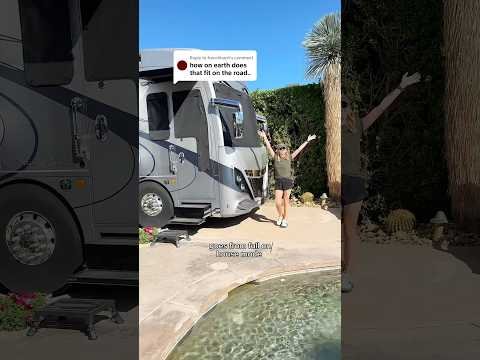
The direct answer from this video is simple: this motorhome is built to work like a house when parked and like a narrower travel rig when it is time to move. Fuel Your Wander is showing the shift from full living mode to road-trip mode, and that change is the whole point. The coach is described as the biggest legal size at 45 feet long, but the number that really defines the experience is not just length. It is the way the space folds, retracts, and compacts around the travel setup.
That is what makes the video useful. It does not treat a large motorhome as a static object. It treats it as a machine that changes shape depending on whether the family is parked or rolling. For anyone who has only seen RVs from the outside, that shift can be hard to picture until someone walks through it carefully.
How the slide outs reshape the living space
The most striking part of the setup is the slide-out system. There are three of them, and the creator explains that they almost double the usable living space when extended. That matters because it is the difference between a coach that feels like a tight vehicle and one that feels genuinely livable inside.
Two slide outs are on the passenger side. One belongs to the bedroom, and the bed has to be folded up before the slides can retract fully. The other houses the kitchen and reclining sofa. Those details tell you a lot about how the interior is organized: the coach is not just wide for the sake of being wide. The layout is built around the spaces people use every day.
On the driver’s side, there is a full-wall slide out. The creator describes it as massive, and that makes sense because it is the piece that most dramatically expands the interior when parked. It is also the only one that runs on hydraulics because of its size and weight. That difference in mechanism is part of the story too. The rig is not using one simple system for everything; it is using the setup that fits each section best.
What travel mode actually looks like inside
Once the slides are in, the motorhome changes character completely. The video shows that the inside gets tight, but not unusable. That is an important distinction. This is not a coach that turns into dead space when traveling. You can still move around, and you can still access everything you need while on the road.
The travel footprint is also more compact than people may assume. With the slides retracted, the motorhome is exactly 8 feet wide. The creator points out that this is the same width as a semi, which gives viewers an easy comparison point. Instead of trying to imagine a massive oversized shape dominating the lane, you can think of it as a long coach that settles into a standard road width.
That road-ready configuration is what makes the whole transformation feel practical rather than theatrical. The coach is large, yes, but the point of the design is to make that size usable in two different modes. Parked, it gives the family room to spread out. Moving, it tightens into a footprint that is still workable from the inside.
Why a rig this size can still be approachable to drive
A lot of people assume that driving a motorhome this large must be a nightmare to learn. The video pushes back on that idea directly. The creator says it is actually pretty easy once you get the hang of it. That is a helpful reminder that size alone does not tell the whole story.
Of course, the video does not pretend a 45-foot motorhome drives like a small van. It clearly is a big rig. But the point being made is more specific: the learning curve may be less intimidating than people expect. The structure of the vehicle, the narrowed travel width, and the coach’s road configuration all work together to make it feel manageable in practice.
That perspective is one reason the video lands as more than a visual flex. It answers a quiet question many viewers probably have but do not always ask out loud: once the slides come in and the house parts lock down, how hard is it really to live with something this large? The answer here is that size and drivability are not automatically the same problem.
The CDL question, answered plainly from the video
The creator also addresses one of the most common assumptions about large RVs: no, you do not need a CDL to drive this size motorhome. That is stated plainly in the transcript, and it gives the video a practical edge. For anyone who sees the coach and immediately assumes it must come with commercial-license complications, the clarification is doing real work.
This is the kind of detail that matters because it changes how viewers think about the vehicle. It does not turn the motorhome into an ordinary ride, but it does remove one major layer of intimidation. The coach may be long, wide, and packed with moving parts, yet the message is that it still fits within a non-commercial RV category.
Why the video works as an RV feature, not just a walkthrough
What makes this video worth paying attention to is its focus on transition. The creator is not simply showing off a large interior or rattling off features. The story is about conversion: house mode to road mode, spacious to compact, parked to moving. That is the part that makes the motorhome memorable.
It is also a smart angle because it helps viewers understand the logic behind the design. The slides are not decorative. The folded bed is not a random complication. The hydraulic wall slide is not just a technical flourish. Every piece supports the basic idea that a motorhome can be both a living space and a vehicle, depending on what the moment calls for.
For anyone curious about the realities of a 45-foot RV, that is the takeaway. The video shows a rig that is large by any normal standard, but still organized around a simple and understandable routine: open it up when you stop, tuck it in when you move, and let the whole coach change shape around the journey.
Watch the original video: https://www.youtube.com/watch?v=4IRnscsFK7A
RECOMMENDATIONS
All About The Life designs from Texas Thread Theory, inspired by the places you go and the stories you bring back.

Go Somewhere. Do Something.
A high-energy adventure design built around the message “Go Somewhere. Do Something.” With travel-inspired route and destination details, it’s made for anyone who is always looking for the next road trip, day trip, weekend escape, or excuse to get out and experience something new.